In recent years organic farming has grown in popularity – supported not least by Prince Charles, The Prince of Wales who is renowned around the world for his stance on the subject. But organic farms and organic farming communities have long promoted the health and environmental benefits of harnessing the earth’s natural goodness, through rejecting the use of artificial chemicals.
One remarkable example is Fordhall Farm. This Community Land Initiative is an industrial and Provident Society with charitable status. It is currently owned by 7500 shareholders from across the UK and indeed around the world who have pooled together to save it from extinction.
The Hollins family have farmed the land for generations but only ever as tenants so when it came under threat in 2001 from a neighbouring enterprise, they placed it into community ownership. This society now owns all of Fordhall Farm but Charlotte and Ben Hollins, at 24 and 22 years of age respectively, are now tenants of the Fordhall Community Land Initiative.
They live in the farm house and manage the farm land and livestock. They also run a farm shop as a commercial business. See www.fordhallfarm.com for full details.
The Fordhall Community Land Initiative and its 7500 shareholders seek to develop Fordhall as an educational resource. Making the most of its organic heritage and wildlife attributes. Their aim is to use Fordhall to re-connect people to food, the environment and most importantly to farming.
There is still a lot of work to be done, but they hope that eventually a Bunk House, Local/organic food tea rooms, and an educational resource room will be built. And in keeping with the premise of the Initiative they state that these will be built from sustainable and recycled materials where possible, and of course using renewable energy. All funds from future shares sold will be used to carry out this work.
Fordhall Farm's organic origins:
"Man must not control nature, that only leads to failure; he must work alongside it and nurture it" Arthur Hollins (1915 - 2005).
Arthur Hollins was just 14 years old when he took over the tenancy of Fordhall after his father passed away. The intensive food production of the war effort meant the land left to Arthur largely consisted of fallow and malnourished soil, but the new farmer soon observed the rich growth in the woodlands And grew to understand that if left to heal herself ‘Mother Earth’ would correct man-made errors. Shortly after the Second World War he vowed never to put chemical fertilisers on the land at Fordhall again.
He let the grassland fields regain their pre-war goodness, and built up a herd of dairy cows and a yoghurt enterprise managed with his first wife, May.
They were amongst the first in the country to make LIVE yoghurt and many famous London and Edinburgh stores soon sought their produce.
A lot of people said Arthur’s ideas were outrageous but he knew his natural approach was the only route to sustainable farming and sustainability is what underpins the
Fordhall Community Land Initiative today.
Sadly Arthur Hollins died in 2005 at the age of 89 but Charlotte and Ben Hollins now have a 100 year lease at the farm and with them at the helm, Ford hall’s heritage and its goal to promote the benefits of organic farming is in safe hands.
Tuesday, March 20, 2007


Touching Base with Bernie Ross
Life, in the last few months, has been strangely challenging. So up and down that I haven’t felt much like writing, which is greatly unusual for me. Each trauma has been compensated with a small step forward and the ultimate focus is now in sight. I used my skill with words (I hope) to extract a decision from my husband’s employers and he has now rightly been retired early on grounds of ill-health; but he’s still fit and able to walk miles. He simply can’t sit at a desk in an open plan office.
On 29th March we move to Scotland to begin a new life. This is where we hope to stay at first:

The lease is not signed and settled yet so we mustn’t count our chickens before they’re hatched. We’ll be starting afresh with just the cream of the cream - our favourite possessions only, our chosen pastimes, and keeping in touch with our chosen friends. There’ll be plenty of room for new adventures and fellowships too, new projects, inspiration, and creative work. I’ll keep my hand in on creative writing: I haven’t deserted you, my students; just give me time.
When I’m confident of email contact in our new location I’ll let you know so that in the feint hope you’ve done an assignment you’ll entrust it to me. I don’t intend to leave dedicated students with an unfinished course.
So trust me when I say that all the jigsaw pieces are falling into place. When I’ve got a proper Internet connection I shall probably contribute here more. Meanwhile the best thing you can do for me and for your writing life is to help Pete by submitting short pieces, commenting on Playground itself, and especially commenting to Pete personally so that he can grow with being an editor.
Bernie Ross ~ March 2007
~ ~
“Cheep, cheep!” went the baby birds.
I bought them in a pet shop.
Mum saw my sad face as I blocked my ears,
pointed to the cage and said, “They’re never nightingales to keep?”
But the sign said they were ‘Nightingales – going CHEAP!’
Thus we learn.
~ ~
Saturday, March 03, 2007
Sitting In My Garden Chair by Chris Barnes
Sitting in my garden chair
Birds are swooping everywhere,
Swallows soaring in the sky,
Garden birds are not shy.
Blackbirds, Wren and Thrush,
Babies in their nest they rush.
Food in beak, in they go,
Babies feeding are not slow.
Down they go onto the ground,
Grubs, insects and worms are found.
Up they sweep, food in beak,
Listen to the babies cheep.
All are fed and happy now,
Back to sleep the babies go.
The feeding frenzy over now,
It’s good to stop and stare,
Sitting in my garden chair.
Birds are swooping everywhere,
Swallows soaring in the sky,
Garden birds are not shy.
Blackbirds, Wren and Thrush,
Babies in their nest they rush.
Food in beak, in they go,
Babies feeding are not slow.
Down they go onto the ground,
Grubs, insects and worms are found.
Up they sweep, food in beak,
Listen to the babies cheep.
All are fed and happy now,
Back to sleep the babies go.
The feeding frenzy over now,
It’s good to stop and stare,
Sitting in my garden chair.
Saturday, February 10, 2007
Volvo Aero by Geryll Alsen
Volvo Aero – the almost unknown Volvo company 
“So you work for Volvo! How nice! Great cars, have one myself actually.”
“I agree, Volvo makes great cars but I work for Volvo Aero where we make aircraft engine components, not cars.”
“Oh, I’ve never heard of Volvo Aero. You know when people say Volvo I always think of the car.”
The above is a typical conversation when I meet someone who is not familiar with the company I work for. Most people have however indirectly been in touch with our products – at least if they’ve been on an airplane.
Volvo Aero is a major supplier of aircraft engine components and we work together with all the big aircraft engine manufacturers in the world, such as Rolls-Royce, General Electric, Pratt & Whitney, Snecma and MTU.
Our components are found on more than 80 percent of all engines supplied worldwide on new aircraft carrying 100 passengers or more. On certain engine types we also perform overhauls and repairs so that they can continue to fly for many more hours.
We don’t just make components for aircraft though; Volvo Aero is also the world’s largest commercial supplier of rocket combustion chambers and exhaust nozzles. We develop and produce engine components for the European Ariane rockets – the world’s market leader in commercial launchers.

When I joined the company in 1979, it was a company with mainly military products. Over the years, the company has transformed and the military part is only about 10 percent today. The military technology and development has however formed the base for our commercial activities and we would not have been so successful without it.
Volvo Aero is an interesting company to work for, and my job in Corporate Communications is highly unpredictable, which I like a lot. One thing I do every day though is to check the company mailbox where people ask all kinds of questions about aerospace and a wide variety of other things. Some people are just Volvo fans and ask for giveaways. A man from Germany once asked for a sticker he could put on his brand new Volvo car. I sent him a Volvo Aero sticker, explaining that we didn’t have any car stickers. Two weeks later I received a large parcel with two bottles of wine - a gift from the German Volvo driver.
The job has its advantages!

“So you work for Volvo! How nice! Great cars, have one myself actually.”
“I agree, Volvo makes great cars but I work for Volvo Aero where we make aircraft engine components, not cars.”
“Oh, I’ve never heard of Volvo Aero. You know when people say Volvo I always think of the car.”
The above is a typical conversation when I meet someone who is not familiar with the company I work for. Most people have however indirectly been in touch with our products – at least if they’ve been on an airplane.
Volvo Aero is a major supplier of aircraft engine components and we work together with all the big aircraft engine manufacturers in the world, such as Rolls-Royce, General Electric, Pratt & Whitney, Snecma and MTU.
Our components are found on more than 80 percent of all engines supplied worldwide on new aircraft carrying 100 passengers or more. On certain engine types we also perform overhauls and repairs so that they can continue to fly for many more hours.
We don’t just make components for aircraft though; Volvo Aero is also the world’s largest commercial supplier of rocket combustion chambers and exhaust nozzles. We develop and produce engine components for the European Ariane rockets – the world’s market leader in commercial launchers.

When I joined the company in 1979, it was a company with mainly military products. Over the years, the company has transformed and the military part is only about 10 percent today. The military technology and development has however formed the base for our commercial activities and we would not have been so successful without it.
Volvo Aero is an interesting company to work for, and my job in Corporate Communications is highly unpredictable, which I like a lot. One thing I do every day though is to check the company mailbox where people ask all kinds of questions about aerospace and a wide variety of other things. Some people are just Volvo fans and ask for giveaways. A man from Germany once asked for a sticker he could put on his brand new Volvo car. I sent him a Volvo Aero sticker, explaining that we didn’t have any car stickers. Two weeks later I received a large parcel with two bottles of wine - a gift from the German Volvo driver.
The job has its advantages!
Thursday, January 04, 2007
Welcome to 2007
Happy New Year to everyone and a special welcome to all the DIY Nutshell students who bought the 'Teach Yourself' version of the course. I hope it proves inspiring and helpful and that you will 'meet' a few likeminded people here. The sky's the limit as far as sharing work and email addresses etc is concerned.
Sadly I'm very preoccupied at the moment but I do find time to write - I MAKE time - and here's a little ditty I've just dashed off when I should be preparing to go out!
The Strength of a Spider’s Web
I’m reminded again of the power of fiction every time I see a spider.
As recently as this past summer I would kill a spider on sight because I’m afraid of them and I know how rapidly they breed. I couldn’t bear to think that ‘one today’ could mean a few hundred tomorrow so I’d squash it; such was my horror at the creatures.
But not any more.
A simple turnaround – not complete, I’m still afraid of them – occurred after reading Charlotte’s Web by E.B. White. I came across it at my son’s house in November and I read it over the weekend while we stayed there. Never again can I think so badly of spiders, I can leave them quietly in the corner harming no-one.
Charlotte’s Web is a children’s story, published way back in the 1950s. I should’ve been given a copy as a child, it would’ve saved many a hiatus over the years and I might not have passed on my phobia to my own kids.
© Bernie Ross 2007
Sadly I'm very preoccupied at the moment but I do find time to write - I MAKE time - and here's a little ditty I've just dashed off when I should be preparing to go out!
The Strength of a Spider’s Web
I’m reminded again of the power of fiction every time I see a spider.
As recently as this past summer I would kill a spider on sight because I’m afraid of them and I know how rapidly they breed. I couldn’t bear to think that ‘one today’ could mean a few hundred tomorrow so I’d squash it; such was my horror at the creatures.
But not any more.
A simple turnaround – not complete, I’m still afraid of them – occurred after reading Charlotte’s Web by E.B. White. I came across it at my son’s house in November and I read it over the weekend while we stayed there. Never again can I think so badly of spiders, I can leave them quietly in the corner harming no-one.
Charlotte’s Web is a children’s story, published way back in the 1950s. I should’ve been given a copy as a child, it would’ve saved many a hiatus over the years and I might not have passed on my phobia to my own kids.
© Bernie Ross 2007
Thursday, November 02, 2006
A Night To Remember by Lynda E Blake
"This sounds interesting Mum, would you like to go?"
"What's that love?" asked Sue's mum glancing up from the vegetables she was peeling.
"It's a talk by Janice Armstrong, a crime writer. I haven't read any of her books but it could be interesting. The newsletter here says the talk is part of the celebrations for Agatha Christie Week."
Frowning Sue's mum sighed. She wasn't much of a reader herself and had even said that she thought it was a waste of time. But Sue knew her mum's weaknesses and was quick to emphasise the crime aspect of the talk. "You like to watch crime shows on the television, don't you? Perhaps she'll talk about those too. You might be surprised."
Reluctantly she agreed to go and a few days later they were in the taxi heading for a library in a nearby city.… They'd hoped to get there early and get a good seat but when they reached the room they were shocked to see there was only one empty chair. Sue had to use a wheelchair these days, and found this embarrassing because it was as if it was a barrier that came between her and other, more active people, whom she found often excluded her from their conversations. But on this occasion she was glad she'd brought her own seat!
The guest author began to speak, but her voice was almost drowned out by a noisy fan which had been positioned directly opposite from where Sue and her mum sat. Janice Armstrong herself commented upon the noisiness of the fan, but no-one made any attempt to change its speed or direction. Neither Sue nor her mum had brought a coat, so in the end Sue's mum got to her feet and turned off the fan altogether. There was an audible gasp from the audience when she did this, but most people had by now wrapped their coats around their shoulders, so perhaps they longed to do what Sue's mum had had the courage to do?
The room fell quiet and everyone settled back to enjoy the rest of the evening, but as they did so one of the organisers stepped forward and thanked Janice Armstrong for her enlightening talk. Thus bringing the proceedings to an abrupt end. Janice Armstrong looked at her watch then down to her so far unused notes lying on the small table at her elbow. "Is it really that time?" She sounded bewildered and her face betrayed the fact that she really hadn't expected anyone to ask her to stop speaking so soon.
Sue couldn't understand it either because the evening seemed to be going so well. Janice Armstrong was clearly relishing the opportunity to share her love of writing with people who had a mutual interest in her craft.
A few people in the audience looked at each other as they slowly rose, but the woman who had sat beside Sue walked silently from the room without so much as a backward glance. No one seemed able to comprehend what had happened.
Sue and her mum didn't know what to do. A man with rather long hair came towards them, "Can I help?" he asked.
"We have to wait for our taxi," explained Sue's mum quietly. The man muttered something and then went back to join Janice Armstrong who was still packing away her belongings.
"What time is it?" asked Sue's mum apprehensively. Sue looked at her watch and told her it was exactly 8pm. They had precisely one hour to wait before James came back to collect them…
If only they had a mobile phone but Sue knew she wouldn't get one because like much of today's technology, they scared her. She was convinced she'd do something terribly wrong and break it.
But as Sue's mum reminded her, James their taxi driver could be miles away. Perhaps on another job? Even if he could collect them straight away it'd be a while before he could reach them. This was turning into a disaster…
Before long another man came towards them and asked if he could help. This man turned out to be a librarian and he led them back into the library itself. They explained the situation and he said they could wait at the desk - and even offered to call James from the phone used by the librarians. Sue told him the number and he picked up the phone and dialled expectantly, but his face changed when James told him he couldn't possibly get there before the time they'd arranged.
Putting the phone down the librarian turned to Sue and asked if there was another taxi they could use? "No," replied Sue's mum. "We know James and he knows us. He knows just what Sue needs and how to help her."
"Oh, I see." Mumbled the librarian.
For a few minutes the librarian and three of his colleagues who had been busying themselves amongst the bookshelves disappeared into a room not accessible to the public. Shortly afterwards five members of staff re-emerged but two of them quickly left the building while the remaining three stayed behind. It must have been decided that they would make sure Sue and her mum didn't wreck the place!
The three librarians who stayed behind were all friendly, and each one in turn chatted with Sue and her mum but the wait seemed to go on forever and it soon became apparent that everyone was getting restless. The librarians went off to re-arrange the books and DVDs. Sue could hear them talking about films they'd seen and longed to join in with their discussion but she rarely watched films. Her vision made it hard for her to recognise unfamiliar characters and often she'd find it hard to keep track of what was going on.
Looking around at the many shelves of books she longed to read too. But even that pleasure was denied her these days - unless she enlisted the help of modern technology, how ironic that the aspect of life which caused her so much angst also enabled her to enjoy such a basic pleasure.
Gazing at the crowded shelves she realised what a small fraction of this wealth of information she'd read. She doubted she'd ever get to access it either which made her sad. For a moment this seemed to put her whole experience of life in a nutshell. There were so many things she'd never know…
All of a sudden her thoughts were dragged back to the problem of the moment though when the first librarian approached them again and suggested they go downstairs. Was he going to throw them out into the street?
Putting a hand on the back of Sue's wheelchair he spoke wearily. "We've had to lock the doors, but you'll be able to see when your taxi driver arrives and then you can give us a shout to come and unlock the door…"
It was pointless arguing, so minutes later they found themselves abandoned in the small glass foyer which looked out onto the street. Sue was starting to feel anxious and didn't like being on show like this. She looked at her watch again. 8.40. "Let's hope he's not delayed," she said hesitantly.
It was dark outside now but only a few people were walking around. The library was close to the city centre, but it was still quite early and perhaps fewer people went out on Tuesday nights? Sue was glad it wasn't a busy night at the weekend with lots of young people milling around.
Fortunately their agony wasn't prolonged though and they both sighed with relief when James' face appeared at the window. But of course they still had to get out and somehow had to let the librarian know. They glanced towards the steep staircase, but there was no sign of anyone and they hadn't asked the librarian's name.
Sue's mum moved towards the stairs and Sue thought she was going to go and find someone, but to her amazement her mum instead shouted out the name "John!"
They never found out if this was a lucky shot, or if the librarian just heard a noise and came running to investigate, but it achieved the desired effect!
On the way home Sue thought over what had happened. Yes, it had been a memorable evening, but not for the reasons they'd expected.
The End
"What's that love?" asked Sue's mum glancing up from the vegetables she was peeling.
"It's a talk by Janice Armstrong, a crime writer. I haven't read any of her books but it could be interesting. The newsletter here says the talk is part of the celebrations for Agatha Christie Week."
Frowning Sue's mum sighed. She wasn't much of a reader herself and had even said that she thought it was a waste of time. But Sue knew her mum's weaknesses and was quick to emphasise the crime aspect of the talk. "You like to watch crime shows on the television, don't you? Perhaps she'll talk about those too. You might be surprised."
Reluctantly she agreed to go and a few days later they were in the taxi heading for a library in a nearby city.… They'd hoped to get there early and get a good seat but when they reached the room they were shocked to see there was only one empty chair. Sue had to use a wheelchair these days, and found this embarrassing because it was as if it was a barrier that came between her and other, more active people, whom she found often excluded her from their conversations. But on this occasion she was glad she'd brought her own seat!
The guest author began to speak, but her voice was almost drowned out by a noisy fan which had been positioned directly opposite from where Sue and her mum sat. Janice Armstrong herself commented upon the noisiness of the fan, but no-one made any attempt to change its speed or direction. Neither Sue nor her mum had brought a coat, so in the end Sue's mum got to her feet and turned off the fan altogether. There was an audible gasp from the audience when she did this, but most people had by now wrapped their coats around their shoulders, so perhaps they longed to do what Sue's mum had had the courage to do?
The room fell quiet and everyone settled back to enjoy the rest of the evening, but as they did so one of the organisers stepped forward and thanked Janice Armstrong for her enlightening talk. Thus bringing the proceedings to an abrupt end. Janice Armstrong looked at her watch then down to her so far unused notes lying on the small table at her elbow. "Is it really that time?" She sounded bewildered and her face betrayed the fact that she really hadn't expected anyone to ask her to stop speaking so soon.
Sue couldn't understand it either because the evening seemed to be going so well. Janice Armstrong was clearly relishing the opportunity to share her love of writing with people who had a mutual interest in her craft.
A few people in the audience looked at each other as they slowly rose, but the woman who had sat beside Sue walked silently from the room without so much as a backward glance. No one seemed able to comprehend what had happened.
Sue and her mum didn't know what to do. A man with rather long hair came towards them, "Can I help?" he asked.
"We have to wait for our taxi," explained Sue's mum quietly. The man muttered something and then went back to join Janice Armstrong who was still packing away her belongings.
"What time is it?" asked Sue's mum apprehensively. Sue looked at her watch and told her it was exactly 8pm. They had precisely one hour to wait before James came back to collect them…
If only they had a mobile phone but Sue knew she wouldn't get one because like much of today's technology, they scared her. She was convinced she'd do something terribly wrong and break it.
But as Sue's mum reminded her, James their taxi driver could be miles away. Perhaps on another job? Even if he could collect them straight away it'd be a while before he could reach them. This was turning into a disaster…
Before long another man came towards them and asked if he could help. This man turned out to be a librarian and he led them back into the library itself. They explained the situation and he said they could wait at the desk - and even offered to call James from the phone used by the librarians. Sue told him the number and he picked up the phone and dialled expectantly, but his face changed when James told him he couldn't possibly get there before the time they'd arranged.
Putting the phone down the librarian turned to Sue and asked if there was another taxi they could use? "No," replied Sue's mum. "We know James and he knows us. He knows just what Sue needs and how to help her."
"Oh, I see." Mumbled the librarian.
For a few minutes the librarian and three of his colleagues who had been busying themselves amongst the bookshelves disappeared into a room not accessible to the public. Shortly afterwards five members of staff re-emerged but two of them quickly left the building while the remaining three stayed behind. It must have been decided that they would make sure Sue and her mum didn't wreck the place!
The three librarians who stayed behind were all friendly, and each one in turn chatted with Sue and her mum but the wait seemed to go on forever and it soon became apparent that everyone was getting restless. The librarians went off to re-arrange the books and DVDs. Sue could hear them talking about films they'd seen and longed to join in with their discussion but she rarely watched films. Her vision made it hard for her to recognise unfamiliar characters and often she'd find it hard to keep track of what was going on.
Looking around at the many shelves of books she longed to read too. But even that pleasure was denied her these days - unless she enlisted the help of modern technology, how ironic that the aspect of life which caused her so much angst also enabled her to enjoy such a basic pleasure.
Gazing at the crowded shelves she realised what a small fraction of this wealth of information she'd read. She doubted she'd ever get to access it either which made her sad. For a moment this seemed to put her whole experience of life in a nutshell. There were so many things she'd never know…
All of a sudden her thoughts were dragged back to the problem of the moment though when the first librarian approached them again and suggested they go downstairs. Was he going to throw them out into the street?
Putting a hand on the back of Sue's wheelchair he spoke wearily. "We've had to lock the doors, but you'll be able to see when your taxi driver arrives and then you can give us a shout to come and unlock the door…"
It was pointless arguing, so minutes later they found themselves abandoned in the small glass foyer which looked out onto the street. Sue was starting to feel anxious and didn't like being on show like this. She looked at her watch again. 8.40. "Let's hope he's not delayed," she said hesitantly.
It was dark outside now but only a few people were walking around. The library was close to the city centre, but it was still quite early and perhaps fewer people went out on Tuesday nights? Sue was glad it wasn't a busy night at the weekend with lots of young people milling around.
Fortunately their agony wasn't prolonged though and they both sighed with relief when James' face appeared at the window. But of course they still had to get out and somehow had to let the librarian know. They glanced towards the steep staircase, but there was no sign of anyone and they hadn't asked the librarian's name.
Sue's mum moved towards the stairs and Sue thought she was going to go and find someone, but to her amazement her mum instead shouted out the name "John!"
They never found out if this was a lucky shot, or if the librarian just heard a noise and came running to investigate, but it achieved the desired effect!
On the way home Sue thought over what had happened. Yes, it had been a memorable evening, but not for the reasons they'd expected.
The End
Thursday, August 24, 2006
Life Styles
This is a long but compelling story and I've put it here in a serif font so that you should be able to print it and read it in a quiet time. Please do so and consider its qualities because Barbara needs feedback. There are some points that would help to make the story even more effective and this is an ideal opportunity for you to learn through Barbara's learning. To teach is to learn twice and here at WL where we write from the heart there's the chance for sharing thoughts without wading through shallow and time-wasting comments such as might be passed at a verbal reading in a writers' group. Here's a serious head-to-head work of endeavour: how can this story be improved? Your comments can be added on the page itself or sent to Barbara via info@creativewritinglife.co.uk
Life Styles: A Story by Barbara A.Rope
The penetrating scream continued. His face became redder by the second. Forehead damp with perspiration and his cheeks wet with tears. The high-pitched noise was unbearable. Blonde curls stuck around his face.
“ Here then, take it,” she said, with apathy in her voice.
Immediately the noise ceased and his small fat hand grabbed out at the packet of crisps. The younger child, Martin, was plucked from the high chair and wiping his face with kitchen roll in one hand and picking up the car keys with the other, Zoe hurried to the car. The drizzle; from the grey overcast sky, made her morning even more unpleasant. She had forgotten to raise the roof of the convertible the night before. Eighteen-month-old Martin, who remained very placid was thrust into the baby seat as she attempted to raise the roof and call three-year-old William to the car. With Martin secured she rushed back into the house to find him attempting to watch a video, the crisps trodden into the lounge carpet.
Zoe was nearing the end of her tether. Without a word she swept him off his feet and carried him, screaming, to the car. With his feet pounding first her and then the car upholstery, she managed to fasten him in his seat. She sighed and backed the car out of the driveway. Glancing at her watch she realised they were late once again.
Quickly and without hesitation she dropped off the boys at the childminders. Her mobile rang, as she was about to drive off. Bradley, her husband spoke curtly into her ear.
“Yes, I’ll be there. Nine o’ clock did you say? Okay, see you. Bye,” she said and sighed heavily.
Bradley hadn’t been the same since he’d got back from Iraq. His last tour of duty had taken its toll, especially on his temper. He was trying hard to fit into civilian life again.
On arriving at the Health Club she snapped down the mirror in the sun-visor, applied lipstick and flicked a brush through her short blonde hair. She looked into her blue eyes momentarily and realised how tired she looked, the dark circles around them telling their own story. She ran her hands down her navy blue skirt and straightened her jacket. After all she was the manager and had to look the part.
*
Mrs. Winston loved her job as childminder. She would always tell people, ‘Serendipity put me here to do this work.' Never revealing the truth about her unhappy past and her inability to have children of her own.
William and Martin loved Mrs. Winston, they fulfilled most of her requests and she provided lovingly all their needs. Martin accepted her as he did most things, always content in her safe company.
“Two of you little ones are enough for me at any one time,” she said and kissed them on the head.
At lunch William sat to the table, with Martin in a high chair beside Mrs. Winston. The meal was eaten quietly and the children had a nap afterwards giving Mrs.Winston time to clear away and prepare for the afternoon.
*
Betty wiped her brow with her apron and stopped to serve to Stan. He was a regular customer and she had become friendly with him over the years. They always chatted about their respective families and the weather. They often put the world to rights on quieter mornings, but this wasn’t one of them. Betty was hot and tired as she put down the heavily stacked plate of burgers, chips, eggs and beans before him. He gave her a beaming smile revealing a few gaps in his teeth, his lined face even more creased. The transport café was heaving, so just a cheerful ‘Thank you’ and ‘Your welcome’ was passed between them. She seemed to hesitate for a moment but then continued with her work.
Stan ate with enthusiasm; he loved his food. Being a long distant lorry driver, meals were the highlight of his day. Soon he sat back from the empty plate sated and sipped his tea. He viewed the room and nodded acknowledgements at familiar faces that looked his way. He looked at his watch, only another few hours to go before he picked up his load to take to Spain.
*
Zoe’s day had become more intense. Sports equipment had broken down and two members of staff had called in sick. The day just flew by. Her stress levels were at an all time high when she realised it was time to pick up the boys. She had managed to eat a banana around lunchtime, other than that nothing. She rang Mrs. Winston with her usual excuse and apology.
“No need to worry my dear. We’re all safe and happy and that’s all that counts,” she said in her philanthropic way.
The piles of paper that lay on Zoe’s desk were pushed into her case for attention when she arrived home. She closed her eyes momentarily as she envisaged the evening of tantrums from William and demands from Bradley along with housework, which seemed endless. Still, she would catch up if she worked into the night. She phoned the different departments to ensure that all the clients had left the building. Her last call would be at reception to check the building was empty and to set the alarms. She tossed her bag onto the passenger seat and jumped into the car. It had drizzled all day and the upholstery still felt damp.
“No doubt Bradley will comment on this,” she said out loud as she drove off.
The short drive to Mrs.Winston’s house only took fifteen minutes. The light was fading into night and the orange sodium streetlights made reflections on the wet road. The sky was still heavy with a blanket of cloud.
William started to protest the moment he saw her. Martin remained in his usual state of indifference.
“Firm but gentle,” advised Mrs.Winston as she saw William change into a little monster.
“You must invest more time with him Zoe or he will break your heart one day,” Mrs Winston suggested with real meaning.
“Time is something I don’t seem to have much of these days,” Zoe replied, her eyes welling with tears. “I know you mean well, but I don’t think you understand the pressure I’m under.” She stopped speaking abruptly; she knew she would break down altogether if she carried on. She cleared her throat.
“Thanks, see you tomorrow,” she said, picking up Martin and grabbing William’s hand.
Mrs. Winston looked out of her bay window; she bit her lip and shook her head. She felt deeply for Zoe as she saw William doing his utmost to prevent her from fastening him in the car seat. She knew how hard the poor woman was working to give her boys the best in life.
Five minutes into the journey and William started to whine. Zoe ignored him. The noise grew enveloping her head, as it became the familiar piercing scream.
*
Stan knew some of the lads at the container depot. He had made this run many times before. This would be his last. The load contained wooden furniture for Spain. The ferry crossing was pleasant enough. It amused him to observe the tourists and holidaymakers who travelled alongside him.
“So many mobile homes,” he murmured to himself as he watched them board.
He liked his work, but he was looking forward to retirement. He was sixty-years-old and he and his wife Anna felt the time was right. They had spoken of their dream many times and now it was going to become reality. They had purchased a house on the Costa Brava and after this trip they would be leaving England to live in Spain.
*
Zoe parked the car at the front of their detached house. Martin was asleep and William was trying to wake him up by kicking his seat. She felt as if her chest was about to explode as she opened the door and put on the lights. Throwing her jacket and bag on the chair she returned for the children. Momentarily pausing in the hallway, she realised she was shaking.
“I hate this bloody house,” she burst out, her bottom lip becoming a straight line as she grit her teeth. Zoe thought of Mrs. Winston and how homely her house felt.
“Stop that noise now,” she shouted as she returned to the car.
William ran into the house as soon as he was released from his seat. She carried Martin into the house, it was almost eight o’clock. Her head was pounding now and she was exhausted. William was banging a toy on the television screen. Zoe could stand it no longer. Grabbing his arm she dragged the screaming child upstairs. She could hear herself shouting in a chant-like way, “Enough, enough.” As she pulled him, the scream became shriller. Roughly undressing him, in a manner unknown to the child, she threw his clothes across the room. William’s scream became a genuine cry as she pulled him into the bathroom and rubbed his face hard with a damp facecloth.
“Now you have something to cry about,” she mumbled with the rhythm of her harsh movements.
William’s chest heaved upwards as each sob engulfed him. He was frightened of his mummy and wanted her to stop. She put her face next to his.
“Now get to bed or I’ll slap you so hard,” she choked in an almost automatic way.
William started to say something, but he didn’t get a chance.
“Shut up now,” she screamed her face red with exertion, spittle collecting in the corners of her mouth.
William ran to his bed sobbing. She slammed the bedroom door hard. Martin was still asleep on the sofa where she had left him. There he remained. Zoe opened the front door and walked out into the dark, damp night air. She walked and walked.
*
Stan stood on the deck of the ferry as it neared the port of Santander. He smiled to himself. A passenger mistook this as a smile and spoke:
“Nearly there now. Looking forward to your visit?” he enquired, not waiting for an answer, he continued.“Me and the wife have just retired, we’re driving through Spain in our mobile home,” he announced with great pride.
Stan smiled more broadly masking his thoughts on mobile homes or the stereotype ideas he had of their occupants.
*
Bradley was furious when Zoe wasn’t waiting for him. He paced the arrivals lounge and tried to phone her, all to no avail. As the taxi drew off, he stood at the front of the house and looked at her car and then their house. Lights shone in the lounge and hallway.
“What the Hell is going on?” he yelled as he burst through the doorway.
The house remained silent. He threw his case and jacket beside the stairs in the entrance hall.
“I said what the….” his voice trailing off as he saw Martin fast asleep on the sofa, fully dressed. His fat cheeks glowing red with the heat as he slept. Bradley realised something was wrong.
“Zoe, Zoe,” he called in a whispered tone.
He took the stairs two at a time. He looked into William’s room, the child oblivious to anything but his dreams. He checked all the rooms, their silence giving him an eerie feeling. He noticed her jacket and case on the chair. He opened the case and saw her mobile, wallet, everything she normally took with her. He swallowed hard and put his head in his hands as he sank into the chair.
It was after midnight and Zoe walked on. Her feet were sore; she was wet and cold. She had no coat, no money and she was lost. She sobbed silently as she looked at the visible street signs. Gradually shops became familiar. Her face wet with snot and tears, she walked back home. Around two o’clock she stood at the front door. Not wanting to wake the children she knocked tentatively. Bradley threw open the door, making it bounce on the doorstop. She stood before him like a waif, wet and tired. Her eyes and nose were red from crying.
“Where the hell have you been?” he yelled into her face.
Zoe stared; she couldn’t speak. She knew she’d done wrong but she just wanted a hug. He didn’t oblige. They slept in separate rooms that night.
Next morning the atmosphere was normal, as if nothing had happened.
“Drop me off at the garage will you? I’ll pick up my car and you can take the kids,” he said in a directive way as he stood in the kitchen eating a bowl of cereals.
William behaved like a model child as the four of them rode in the car. Bradley unfastened his seatbelt on arrival at the garage. He leant forward towards Zoe, as if to kiss her. Instead he whispered in her ear: “If you ever leave the boys again, you will never see them again. Got that?”
He left the car, but before closing the door he waved to the boys.
“I’ll be eating out after I go to the gym tonight. Don’t wait up for me,” his words cutting into Zoe’s chest.
She drove off, her chest tight and her stomach feeling as if she had a stone in it. Automatically she unfastened the boys on arrival at Mrs.Winston’s house. She came out to meet them; they were early for once. Mrs. Winston’s heart sank when she saw Zoe’s face.
“I won’t ask if you have time for a coffee, but I’ll give you one all the same.” She herded Zoe indoors. The boys went into the playroom and played happily together.
“Now you can tell me it’s none of my business and I’ll try and keep my nose out, but you look so unhappy.”
Mrs Winston looked into Zoe’s tired eyes, her own big brown ones smiling gently. Zoe didn’t need any prompting. She exhaled sharply and fell into a deluge of tears. Mrs. Winston held her close giving her the hug that she needed so badly. Through the tears she told her everything. Mrs.Winston persuaded Zoe to ring work and explain that she was ill.
*
Driving towards Burgos in his high-tech cab complete with satellite navigation system, Stan felt relaxed and happy cruising through the Picos de Europa mountain range. He laughed to himself as he was reminded of his wife Anna’s remarks about the cab looking like the Star Ship ‘Enterprise.’ He would be sad in some ways to leave this part of the job. The sun was shining, the scenery good and the autopista quiet at this hour. After driving for a while he suddenly noticed a red light flashing furiously on his vast dashboard. One became several. He looked for a place to pull in and fortunately came to a rest area.
“Now what’s up girl?” he said with affection in his voice.
He sat in the cab with the engine running to diagnose the problem, but it didn’t seem to make any sense. More lights were flashing and it confused him as to what was wrong. He turned off the engine and walked around the long white sides. He examined all the area where the cab joined the load. Everything appeared to be fine. It was company policy that the driver rang in the moment there was a problem, so Stan pulled out his mobile. It was dead; no signal, he pursed his lips and jumped back into the cab.
“Well at least they’ll know where I am,” he comforted himself looking at the navigation system that seemed to be flickering on and off.
“You stay there girl,” he chuntered and started to walk towards a yellow emergency phone he could see in the distance by the roadside.
The sun felt warm on his face as he walked, although he wished he’d remembered to bring his water bottle. On reaching the phone he started to feel hot and sweaty. The phone was out of order. He looked in the distance for another one.
“No, I’ll go back and stop the next passer-by,” he murmured to himself.
Red faced and puffing he walked the slight incline back to the truck. He decided he would have to lose some weight and start eating a healthier diet. Anna had given him this advice, but he was beginning to realise it was a must.
“Surely somebody will be passing this way soon,” he said as he leant against the side of the truck in the shade, drinking the last of his water.
He noticed there was a slight smell of burning in the air, and hoped and prayed it was nothing to do with the engine. Stan who was normally a calm man was beginning to lose his temper. He thumped the side of the cab.
“One more try, come on girl don’t let me down. After all I’ve got no funny noises and it’s just flashing lights. We can do it,” he said, as he jumped back into the cab.
The engine wouldn’t even start. He thumped the steering wheel with his fist.
“Thanks a lot,” he grumbled and sat in the cab without air conditioning. He decided to sit in the shade under a tree so he could see the road. The ground was hard and dusty. The faint smell of burning was getting stronger. He looked around, but could see nothing. Time ticked on.
“Why is it when you want somebody there is nobody about? And yet the minute you stop for a piss, the whole bloody world passes by,” he moaned to himself.
“Right that’s it I’ll take a piss.”
He relieved himself at the back of the tree but nobody appeared. Then wisps of smoke from somewhere near the truck caught his attention. He couldn’t detect where because the whole of the truck was white and nothing seemed to show.
*
Zoe stayed in the kitchen whilst Mrs. Winston went about her daily duties. She was sitting in a big old rocking chair holding an empty cup of coffee. Mrs. Winston had listened, but had made no comments about her behaviour.
After a while Zoe stood and watched the children through the serving hatch. They didn’t know she was there. She wondered at the interaction of her own children and Mrs. Winston. Martin was lively and inquisitive; William was well behaved and helpful.
“I must be the worst mother ever,” she whimpered into her hands.
Mrs. Winston returned to the kitchen leaving the children engaged in play.
“Tears are not going to make this situation any better, my dear,” she said rationally.
“Come on now let’s sort out your life.”
Zoe looked surprised at Mrs. Winston’s direct comment.
“Well you do want to, don’t you?” came the reaction.
*
Stan was busy looking up the road. He missed the first few flames that licked around the cab, small at first and pale yellow in colour. The black dense smoke was the indicator that he had big trouble. He stood frozen for the moment. He was unable to think clearly. His entire mind seemed to want to concentrate on the photograph of Anna in the cab. After taking two steps forward from the shade of the tree he became conscious there was nothing he could achieve by moving closer. The flames had taken hold and nothing as simple as a fire extinguisher was going to do anything about the dreadful event. The fire had become a living being, lashing its arms around the vehicle, bellowing thick black smoke and roaring with an excited tenor. As it grew Stan walked backwards towards the tree, fascinated at the speed the fireball ate all before it. By the second, the heat and noise grew, he stood before a cracking, snarling inferno and he was frightened. Fortunately there was no wind so the black plumes rose into the sky above, even so he was concerned about the spread of this dreadful creature into the adjoining area.
“For God’s sake will somebody please pass by,” he shouted, above the loud cracks and roars of the fire.
As if by magic, he noticed a vehicle on the horizon to his left.
“Thank God. Help at last,” he choked, his emotions beginning to release themselves.
The feeling of tears changed to those of giggles within his chest when he realized it was a mobile home coming towards him.
“Just my luck, mister-bloody-middle-class here to save the day,” Stan said quietly to himself as the vehicle drew up.
“We meet again,” said the man from the ferry.
He held out a hand as he jumped out of the mobile home.
“You’re not hurt are you?” he smiled as he grabbed Stan’s hand, placing the other around his shoulders as if to protect him.
Suddenly Stan started to feel the magnitude of the event. It hadn’t crossed his mind that he may have been hurt.
“No, I’m fine, a bit shaken I must confess, but no I’m fine,” he replied feeling a little dazed.
Overhead they could hear the throbbing sound of the blades of a helicopter circling the smoke filled air.
“Why don’t we go and have a cup of tea in the van and let the professionals deal with this,” the man said graciously.
Stan walked to the mobile home with his rescuer’s arm still over his shoulder. He was glad for the feeling of human contact.
*
“You’ve got to ask yourself some pretty hard questions now Zoe. Why don’t you get in touch with your mother and ask her advice?” Mrs. Winston enquired.
Zoe looked at her feet, her eyes dull and staring.
“Because Bradley wouldn’t like it,” she replied almost in a whisper.
“My goodness girl, you’re a manager of a club and you don’t make decisions in your own home. What is going on there?” she retorted, in her normal brusque way.
Zoe raised her head and explained how driven Bradley had become about his home, his appearance, and his quality of life. She explained that he was so extremely competitive, always wanting the biggest house, the best car, even down to the fittest body.
“What has that to do with you and your mother?” Mrs. Winston continued.
“He doesn’t think they are…..” sobs engulfed the rest of the sentence.
After a full day with Mrs. Winston and a nap in the afternoon, Zoe felt stronger and more positive about what she must do. She played with the children for ten minutes before they left for home. The children responded well.
Bradley arrived home at ten. He went straight to the television and turned it on. Zoe leaped up and turned it off.
“We must talk,” she said in a resolute tone, but trying not to sound argumentative.
“Zoe I’m tired and I don’t want to talk, okay,” he said, as he searched for the handset.
“Well I do and you’re going to listen,” she said, beginning to feel a little unsure of herself.
“I’m going to work part-time and spend more time with the children. And I want you to help me more around the house.” she announced.
“Not with this mortgage you’re not,” he replied with authority.
“Then we sell the house and one of the cars, we could down size and live well from both our incomes,” she tried to explain.
Bradley had heard enough.
“You lazy bitch, planned this one well haven’t you?” he snapped and strode into the kitchen. “You’re changing nothing,” he continued to shout.
She tried again, but he wouldn’t listen. They slept in separate rooms again that night.
Next morning Zoe was up and had the children in the car earlier than usual. Because she wasn’t so stressed about time, they seemed to be responding better. This alone was proof for Zoe she needed to change their lives.
*
Mrs. Winston was surprised at the early callers. Zoe explained she was going to leave the children as usual, but she was going to see her mother. She also explained she hadn’t seen her for over a year because Bradley didn’t like their influence on her or the children. She wanted to say how sorry she was and to ask for help. Mrs. Winston warned her.
“Humble pie may be the dish of the day. You need her and I’m sure she will help you. Good luck my girl.”
*
Stan entered the mobile home to feel the cool air conditioning relieving his discomfort. He sat on the plush sofa and placed his head in his hands. Outside was a frenzy of activity.
“My last run,” he said solemnly as he accepted a glass of ice cold water.
He raised his head to thank the woman who stood before him. She passed him the glass and was about to turn away when she realised.
“I retire and come to Spain and I still finish up serving you,” she said with a chuckle in her voice.
“Betty?”
“I take it you two know each other,” said Norman in a dry tone.
The trio talked for a while and then the police allowed them to drive on to Burgos. Fortunately, Stan had always carried a body pouch with his documents, passport and licence. He informed his company about the event and they told him to return as soon as possible with a fire and police report.
“What do you do now?” asked Norman.
“I have no idea,” replied Stan and the three of them laughed.
“We might as well make a day of it until your company rings you back,” suggested Betty.
“Where to next?” asked Norman.
Stan started to like the idea of the freedom of the road in the mobile home. They weren’t anything like he had imagined and it made him think of his life in the future and of being stuck in one place. The more he thought about it, the more he liked the idea of travelling. How would he broach the idea to Anna? She loved the little house they had bought in Spain and had spent many a happy holiday there already.
*
Zoe pulled up outside her parent’s home. She was calmer than she had been for weeks. She practiced the words as she approached the front door, which flew open as she stood there.
“How bad is it Zoe? Is he hurt? Have they contacted you?” cried her mother.
Suddenly her mother’s arms enveloped her. Her wet face pressed close to hers.
This wasn’t the reception Zoe had expected and was totally confused as to what was happening.
The telephone was ringing as they entered the lounge. Her mother snatched at the receiver. She was crying again only they were tears of joy this time. Zoe observed her mother and realised how vulnerable she was. They made tea together and talked. The unknown crisis had provided a perfect reunion in her mother’s moment of need.
Zoe was able to unburden herself totally.
“Maybe you and the boys could come and live with us in Spain?” said her mother with warmth in her heart.
“Maybe?” mumbled Zoe a little unsure of such drastic changes.
*
Mrs. Winston didn’t recognise the car that pulled up outside. It was only five o’clock and Zoe wasn’t due until around six-thirty. A tall dark handsome man strode purposefully up to the door and knocked hard, ignoring the bell. Mrs.Winston put the door on the chain and opened it.
“I’ve come for my sons,” Bradley announced.
William and Martin heard his voice and responded well. She opened the door and they ran to him. He swept them up in his strong lean arms.
“Zoe never mentioned you coming today,” Mrs. Winston said shaking her head.
“That’s okay, Zoe is too busy and I thought I’d help out a bit,” Bradley smiled with a boy in each arm.
The boys waved and laughed as their daddy put them into his car. Mrs Winston noticed none of them were wearing seat belts.
*
“So it’s settled then, we’ll be in touch when I get back to England. Anna and I’ll meet you and we can spend some time together.” Stan said with enthusiasm.
Betty and Norman waved off their friend as he went for his flight. A full day together had made them feel close. They left Barcelona happy and content.
*
Zoe sat in the police car, at the front of her house, with a policewoman by her side. The drive from Mrs Winston’s had made her feel apprehensive, but now she was totally numb with shock. She couldn’t speak. Voices around her sounded as if they were in a dream. People’s movements seem to be in slow motion. She felt the stickiness of blood on her hands. People were talking to her, but she couldn’t hear them. The flashing lights hypnotized her as she stared into space. Her mother’s voice was the only familiar one, she recognised. They took her away in a car. They gave her a drink. She slept alone.
*
Mrs. Winston pulled the newspaper out of the letterbox. She yawned and rubbed the sleep from her eyes as she spread the paper on the kitchen table.
The photograph of William and Martin sitting close together and smiling hit her in the face. Slowly she read the headline. Murdered. She could hardly read on. Sobbing over the newspaper she read through a blur of how their father had taken their lives by shooting them and then had taken his own life.
Zoe lay cradled in her mother’s arms in her familiar childhood room.
“Boy have I got something to tell you,” shouted Stan as he bounced through the front door.
4,977 Words.
Life Styles: A Story by Barbara A.Rope
The penetrating scream continued. His face became redder by the second. Forehead damp with perspiration and his cheeks wet with tears. The high-pitched noise was unbearable. Blonde curls stuck around his face.
“ Here then, take it,” she said, with apathy in her voice.
Immediately the noise ceased and his small fat hand grabbed out at the packet of crisps. The younger child, Martin, was plucked from the high chair and wiping his face with kitchen roll in one hand and picking up the car keys with the other, Zoe hurried to the car. The drizzle; from the grey overcast sky, made her morning even more unpleasant. She had forgotten to raise the roof of the convertible the night before. Eighteen-month-old Martin, who remained very placid was thrust into the baby seat as she attempted to raise the roof and call three-year-old William to the car. With Martin secured she rushed back into the house to find him attempting to watch a video, the crisps trodden into the lounge carpet.
Zoe was nearing the end of her tether. Without a word she swept him off his feet and carried him, screaming, to the car. With his feet pounding first her and then the car upholstery, she managed to fasten him in his seat. She sighed and backed the car out of the driveway. Glancing at her watch she realised they were late once again.
Quickly and without hesitation she dropped off the boys at the childminders. Her mobile rang, as she was about to drive off. Bradley, her husband spoke curtly into her ear.
“Yes, I’ll be there. Nine o’ clock did you say? Okay, see you. Bye,” she said and sighed heavily.
Bradley hadn’t been the same since he’d got back from Iraq. His last tour of duty had taken its toll, especially on his temper. He was trying hard to fit into civilian life again.
On arriving at the Health Club she snapped down the mirror in the sun-visor, applied lipstick and flicked a brush through her short blonde hair. She looked into her blue eyes momentarily and realised how tired she looked, the dark circles around them telling their own story. She ran her hands down her navy blue skirt and straightened her jacket. After all she was the manager and had to look the part.
*
Mrs. Winston loved her job as childminder. She would always tell people, ‘Serendipity put me here to do this work.' Never revealing the truth about her unhappy past and her inability to have children of her own.
William and Martin loved Mrs. Winston, they fulfilled most of her requests and she provided lovingly all their needs. Martin accepted her as he did most things, always content in her safe company.
“Two of you little ones are enough for me at any one time,” she said and kissed them on the head.
At lunch William sat to the table, with Martin in a high chair beside Mrs. Winston. The meal was eaten quietly and the children had a nap afterwards giving Mrs.Winston time to clear away and prepare for the afternoon.
*
Betty wiped her brow with her apron and stopped to serve to Stan. He was a regular customer and she had become friendly with him over the years. They always chatted about their respective families and the weather. They often put the world to rights on quieter mornings, but this wasn’t one of them. Betty was hot and tired as she put down the heavily stacked plate of burgers, chips, eggs and beans before him. He gave her a beaming smile revealing a few gaps in his teeth, his lined face even more creased. The transport café was heaving, so just a cheerful ‘Thank you’ and ‘Your welcome’ was passed between them. She seemed to hesitate for a moment but then continued with her work.
Stan ate with enthusiasm; he loved his food. Being a long distant lorry driver, meals were the highlight of his day. Soon he sat back from the empty plate sated and sipped his tea. He viewed the room and nodded acknowledgements at familiar faces that looked his way. He looked at his watch, only another few hours to go before he picked up his load to take to Spain.
*
Zoe’s day had become more intense. Sports equipment had broken down and two members of staff had called in sick. The day just flew by. Her stress levels were at an all time high when she realised it was time to pick up the boys. She had managed to eat a banana around lunchtime, other than that nothing. She rang Mrs. Winston with her usual excuse and apology.
“No need to worry my dear. We’re all safe and happy and that’s all that counts,” she said in her philanthropic way.
The piles of paper that lay on Zoe’s desk were pushed into her case for attention when she arrived home. She closed her eyes momentarily as she envisaged the evening of tantrums from William and demands from Bradley along with housework, which seemed endless. Still, she would catch up if she worked into the night. She phoned the different departments to ensure that all the clients had left the building. Her last call would be at reception to check the building was empty and to set the alarms. She tossed her bag onto the passenger seat and jumped into the car. It had drizzled all day and the upholstery still felt damp.
“No doubt Bradley will comment on this,” she said out loud as she drove off.
The short drive to Mrs.Winston’s house only took fifteen minutes. The light was fading into night and the orange sodium streetlights made reflections on the wet road. The sky was still heavy with a blanket of cloud.
William started to protest the moment he saw her. Martin remained in his usual state of indifference.
“Firm but gentle,” advised Mrs.Winston as she saw William change into a little monster.
“You must invest more time with him Zoe or he will break your heart one day,” Mrs Winston suggested with real meaning.
“Time is something I don’t seem to have much of these days,” Zoe replied, her eyes welling with tears. “I know you mean well, but I don’t think you understand the pressure I’m under.” She stopped speaking abruptly; she knew she would break down altogether if she carried on. She cleared her throat.
“Thanks, see you tomorrow,” she said, picking up Martin and grabbing William’s hand.
Mrs. Winston looked out of her bay window; she bit her lip and shook her head. She felt deeply for Zoe as she saw William doing his utmost to prevent her from fastening him in the car seat. She knew how hard the poor woman was working to give her boys the best in life.
Five minutes into the journey and William started to whine. Zoe ignored him. The noise grew enveloping her head, as it became the familiar piercing scream.
*
Stan knew some of the lads at the container depot. He had made this run many times before. This would be his last. The load contained wooden furniture for Spain. The ferry crossing was pleasant enough. It amused him to observe the tourists and holidaymakers who travelled alongside him.
“So many mobile homes,” he murmured to himself as he watched them board.
He liked his work, but he was looking forward to retirement. He was sixty-years-old and he and his wife Anna felt the time was right. They had spoken of their dream many times and now it was going to become reality. They had purchased a house on the Costa Brava and after this trip they would be leaving England to live in Spain.
*
Zoe parked the car at the front of their detached house. Martin was asleep and William was trying to wake him up by kicking his seat. She felt as if her chest was about to explode as she opened the door and put on the lights. Throwing her jacket and bag on the chair she returned for the children. Momentarily pausing in the hallway, she realised she was shaking.
“I hate this bloody house,” she burst out, her bottom lip becoming a straight line as she grit her teeth. Zoe thought of Mrs. Winston and how homely her house felt.
“Stop that noise now,” she shouted as she returned to the car.
William ran into the house as soon as he was released from his seat. She carried Martin into the house, it was almost eight o’clock. Her head was pounding now and she was exhausted. William was banging a toy on the television screen. Zoe could stand it no longer. Grabbing his arm she dragged the screaming child upstairs. She could hear herself shouting in a chant-like way, “Enough, enough.” As she pulled him, the scream became shriller. Roughly undressing him, in a manner unknown to the child, she threw his clothes across the room. William’s scream became a genuine cry as she pulled him into the bathroom and rubbed his face hard with a damp facecloth.
“Now you have something to cry about,” she mumbled with the rhythm of her harsh movements.
William’s chest heaved upwards as each sob engulfed him. He was frightened of his mummy and wanted her to stop. She put her face next to his.
“Now get to bed or I’ll slap you so hard,” she choked in an almost automatic way.
William started to say something, but he didn’t get a chance.
“Shut up now,” she screamed her face red with exertion, spittle collecting in the corners of her mouth.
William ran to his bed sobbing. She slammed the bedroom door hard. Martin was still asleep on the sofa where she had left him. There he remained. Zoe opened the front door and walked out into the dark, damp night air. She walked and walked.
*
Stan stood on the deck of the ferry as it neared the port of Santander. He smiled to himself. A passenger mistook this as a smile and spoke:
“Nearly there now. Looking forward to your visit?” he enquired, not waiting for an answer, he continued.“Me and the wife have just retired, we’re driving through Spain in our mobile home,” he announced with great pride.
Stan smiled more broadly masking his thoughts on mobile homes or the stereotype ideas he had of their occupants.
*
Bradley was furious when Zoe wasn’t waiting for him. He paced the arrivals lounge and tried to phone her, all to no avail. As the taxi drew off, he stood at the front of the house and looked at her car and then their house. Lights shone in the lounge and hallway.
“What the Hell is going on?” he yelled as he burst through the doorway.
The house remained silent. He threw his case and jacket beside the stairs in the entrance hall.
“I said what the….” his voice trailing off as he saw Martin fast asleep on the sofa, fully dressed. His fat cheeks glowing red with the heat as he slept. Bradley realised something was wrong.
“Zoe, Zoe,” he called in a whispered tone.
He took the stairs two at a time. He looked into William’s room, the child oblivious to anything but his dreams. He checked all the rooms, their silence giving him an eerie feeling. He noticed her jacket and case on the chair. He opened the case and saw her mobile, wallet, everything she normally took with her. He swallowed hard and put his head in his hands as he sank into the chair.
It was after midnight and Zoe walked on. Her feet were sore; she was wet and cold. She had no coat, no money and she was lost. She sobbed silently as she looked at the visible street signs. Gradually shops became familiar. Her face wet with snot and tears, she walked back home. Around two o’clock she stood at the front door. Not wanting to wake the children she knocked tentatively. Bradley threw open the door, making it bounce on the doorstop. She stood before him like a waif, wet and tired. Her eyes and nose were red from crying.
“Where the hell have you been?” he yelled into her face.
Zoe stared; she couldn’t speak. She knew she’d done wrong but she just wanted a hug. He didn’t oblige. They slept in separate rooms that night.
Next morning the atmosphere was normal, as if nothing had happened.
“Drop me off at the garage will you? I’ll pick up my car and you can take the kids,” he said in a directive way as he stood in the kitchen eating a bowl of cereals.
William behaved like a model child as the four of them rode in the car. Bradley unfastened his seatbelt on arrival at the garage. He leant forward towards Zoe, as if to kiss her. Instead he whispered in her ear: “If you ever leave the boys again, you will never see them again. Got that?”
He left the car, but before closing the door he waved to the boys.
“I’ll be eating out after I go to the gym tonight. Don’t wait up for me,” his words cutting into Zoe’s chest.
She drove off, her chest tight and her stomach feeling as if she had a stone in it. Automatically she unfastened the boys on arrival at Mrs.Winston’s house. She came out to meet them; they were early for once. Mrs. Winston’s heart sank when she saw Zoe’s face.
“I won’t ask if you have time for a coffee, but I’ll give you one all the same.” She herded Zoe indoors. The boys went into the playroom and played happily together.
“Now you can tell me it’s none of my business and I’ll try and keep my nose out, but you look so unhappy.”
Mrs Winston looked into Zoe’s tired eyes, her own big brown ones smiling gently. Zoe didn’t need any prompting. She exhaled sharply and fell into a deluge of tears. Mrs. Winston held her close giving her the hug that she needed so badly. Through the tears she told her everything. Mrs.Winston persuaded Zoe to ring work and explain that she was ill.
*
Driving towards Burgos in his high-tech cab complete with satellite navigation system, Stan felt relaxed and happy cruising through the Picos de Europa mountain range. He laughed to himself as he was reminded of his wife Anna’s remarks about the cab looking like the Star Ship ‘Enterprise.’ He would be sad in some ways to leave this part of the job. The sun was shining, the scenery good and the autopista quiet at this hour. After driving for a while he suddenly noticed a red light flashing furiously on his vast dashboard. One became several. He looked for a place to pull in and fortunately came to a rest area.
“Now what’s up girl?” he said with affection in his voice.
He sat in the cab with the engine running to diagnose the problem, but it didn’t seem to make any sense. More lights were flashing and it confused him as to what was wrong. He turned off the engine and walked around the long white sides. He examined all the area where the cab joined the load. Everything appeared to be fine. It was company policy that the driver rang in the moment there was a problem, so Stan pulled out his mobile. It was dead; no signal, he pursed his lips and jumped back into the cab.
“Well at least they’ll know where I am,” he comforted himself looking at the navigation system that seemed to be flickering on and off.
“You stay there girl,” he chuntered and started to walk towards a yellow emergency phone he could see in the distance by the roadside.
The sun felt warm on his face as he walked, although he wished he’d remembered to bring his water bottle. On reaching the phone he started to feel hot and sweaty. The phone was out of order. He looked in the distance for another one.
“No, I’ll go back and stop the next passer-by,” he murmured to himself.
Red faced and puffing he walked the slight incline back to the truck. He decided he would have to lose some weight and start eating a healthier diet. Anna had given him this advice, but he was beginning to realise it was a must.
“Surely somebody will be passing this way soon,” he said as he leant against the side of the truck in the shade, drinking the last of his water.
He noticed there was a slight smell of burning in the air, and hoped and prayed it was nothing to do with the engine. Stan who was normally a calm man was beginning to lose his temper. He thumped the side of the cab.
“One more try, come on girl don’t let me down. After all I’ve got no funny noises and it’s just flashing lights. We can do it,” he said, as he jumped back into the cab.
The engine wouldn’t even start. He thumped the steering wheel with his fist.
“Thanks a lot,” he grumbled and sat in the cab without air conditioning. He decided to sit in the shade under a tree so he could see the road. The ground was hard and dusty. The faint smell of burning was getting stronger. He looked around, but could see nothing. Time ticked on.
“Why is it when you want somebody there is nobody about? And yet the minute you stop for a piss, the whole bloody world passes by,” he moaned to himself.
“Right that’s it I’ll take a piss.”
He relieved himself at the back of the tree but nobody appeared. Then wisps of smoke from somewhere near the truck caught his attention. He couldn’t detect where because the whole of the truck was white and nothing seemed to show.
*
Zoe stayed in the kitchen whilst Mrs. Winston went about her daily duties. She was sitting in a big old rocking chair holding an empty cup of coffee. Mrs. Winston had listened, but had made no comments about her behaviour.
After a while Zoe stood and watched the children through the serving hatch. They didn’t know she was there. She wondered at the interaction of her own children and Mrs. Winston. Martin was lively and inquisitive; William was well behaved and helpful.
“I must be the worst mother ever,” she whimpered into her hands.
Mrs. Winston returned to the kitchen leaving the children engaged in play.
“Tears are not going to make this situation any better, my dear,” she said rationally.
“Come on now let’s sort out your life.”
Zoe looked surprised at Mrs. Winston’s direct comment.
“Well you do want to, don’t you?” came the reaction.
*
Stan was busy looking up the road. He missed the first few flames that licked around the cab, small at first and pale yellow in colour. The black dense smoke was the indicator that he had big trouble. He stood frozen for the moment. He was unable to think clearly. His entire mind seemed to want to concentrate on the photograph of Anna in the cab. After taking two steps forward from the shade of the tree he became conscious there was nothing he could achieve by moving closer. The flames had taken hold and nothing as simple as a fire extinguisher was going to do anything about the dreadful event. The fire had become a living being, lashing its arms around the vehicle, bellowing thick black smoke and roaring with an excited tenor. As it grew Stan walked backwards towards the tree, fascinated at the speed the fireball ate all before it. By the second, the heat and noise grew, he stood before a cracking, snarling inferno and he was frightened. Fortunately there was no wind so the black plumes rose into the sky above, even so he was concerned about the spread of this dreadful creature into the adjoining area.
“For God’s sake will somebody please pass by,” he shouted, above the loud cracks and roars of the fire.
As if by magic, he noticed a vehicle on the horizon to his left.
“Thank God. Help at last,” he choked, his emotions beginning to release themselves.
The feeling of tears changed to those of giggles within his chest when he realized it was a mobile home coming towards him.
“Just my luck, mister-bloody-middle-class here to save the day,” Stan said quietly to himself as the vehicle drew up.
“We meet again,” said the man from the ferry.
He held out a hand as he jumped out of the mobile home.
“You’re not hurt are you?” he smiled as he grabbed Stan’s hand, placing the other around his shoulders as if to protect him.
Suddenly Stan started to feel the magnitude of the event. It hadn’t crossed his mind that he may have been hurt.
“No, I’m fine, a bit shaken I must confess, but no I’m fine,” he replied feeling a little dazed.
Overhead they could hear the throbbing sound of the blades of a helicopter circling the smoke filled air.
“Why don’t we go and have a cup of tea in the van and let the professionals deal with this,” the man said graciously.
Stan walked to the mobile home with his rescuer’s arm still over his shoulder. He was glad for the feeling of human contact.
*
“You’ve got to ask yourself some pretty hard questions now Zoe. Why don’t you get in touch with your mother and ask her advice?” Mrs. Winston enquired.
Zoe looked at her feet, her eyes dull and staring.
“Because Bradley wouldn’t like it,” she replied almost in a whisper.
“My goodness girl, you’re a manager of a club and you don’t make decisions in your own home. What is going on there?” she retorted, in her normal brusque way.
Zoe raised her head and explained how driven Bradley had become about his home, his appearance, and his quality of life. She explained that he was so extremely competitive, always wanting the biggest house, the best car, even down to the fittest body.
“What has that to do with you and your mother?” Mrs. Winston continued.
“He doesn’t think they are…..” sobs engulfed the rest of the sentence.
After a full day with Mrs. Winston and a nap in the afternoon, Zoe felt stronger and more positive about what she must do. She played with the children for ten minutes before they left for home. The children responded well.
Bradley arrived home at ten. He went straight to the television and turned it on. Zoe leaped up and turned it off.
“We must talk,” she said in a resolute tone, but trying not to sound argumentative.
“Zoe I’m tired and I don’t want to talk, okay,” he said, as he searched for the handset.
“Well I do and you’re going to listen,” she said, beginning to feel a little unsure of herself.
“I’m going to work part-time and spend more time with the children. And I want you to help me more around the house.” she announced.
“Not with this mortgage you’re not,” he replied with authority.
“Then we sell the house and one of the cars, we could down size and live well from both our incomes,” she tried to explain.
Bradley had heard enough.
“You lazy bitch, planned this one well haven’t you?” he snapped and strode into the kitchen. “You’re changing nothing,” he continued to shout.
She tried again, but he wouldn’t listen. They slept in separate rooms again that night.
Next morning Zoe was up and had the children in the car earlier than usual. Because she wasn’t so stressed about time, they seemed to be responding better. This alone was proof for Zoe she needed to change their lives.
*
Mrs. Winston was surprised at the early callers. Zoe explained she was going to leave the children as usual, but she was going to see her mother. She also explained she hadn’t seen her for over a year because Bradley didn’t like their influence on her or the children. She wanted to say how sorry she was and to ask for help. Mrs. Winston warned her.
“Humble pie may be the dish of the day. You need her and I’m sure she will help you. Good luck my girl.”
*
Stan entered the mobile home to feel the cool air conditioning relieving his discomfort. He sat on the plush sofa and placed his head in his hands. Outside was a frenzy of activity.
“My last run,” he said solemnly as he accepted a glass of ice cold water.
He raised his head to thank the woman who stood before him. She passed him the glass and was about to turn away when she realised.
“I retire and come to Spain and I still finish up serving you,” she said with a chuckle in her voice.
“Betty?”
“I take it you two know each other,” said Norman in a dry tone.
The trio talked for a while and then the police allowed them to drive on to Burgos. Fortunately, Stan had always carried a body pouch with his documents, passport and licence. He informed his company about the event and they told him to return as soon as possible with a fire and police report.
“What do you do now?” asked Norman.
“I have no idea,” replied Stan and the three of them laughed.
“We might as well make a day of it until your company rings you back,” suggested Betty.
“Where to next?” asked Norman.
Stan started to like the idea of the freedom of the road in the mobile home. They weren’t anything like he had imagined and it made him think of his life in the future and of being stuck in one place. The more he thought about it, the more he liked the idea of travelling. How would he broach the idea to Anna? She loved the little house they had bought in Spain and had spent many a happy holiday there already.
*
Zoe pulled up outside her parent’s home. She was calmer than she had been for weeks. She practiced the words as she approached the front door, which flew open as she stood there.
“How bad is it Zoe? Is he hurt? Have they contacted you?” cried her mother.
Suddenly her mother’s arms enveloped her. Her wet face pressed close to hers.
This wasn’t the reception Zoe had expected and was totally confused as to what was happening.
The telephone was ringing as they entered the lounge. Her mother snatched at the receiver. She was crying again only they were tears of joy this time. Zoe observed her mother and realised how vulnerable she was. They made tea together and talked. The unknown crisis had provided a perfect reunion in her mother’s moment of need.
Zoe was able to unburden herself totally.
“Maybe you and the boys could come and live with us in Spain?” said her mother with warmth in her heart.
“Maybe?” mumbled Zoe a little unsure of such drastic changes.
*
Mrs. Winston didn’t recognise the car that pulled up outside. It was only five o’clock and Zoe wasn’t due until around six-thirty. A tall dark handsome man strode purposefully up to the door and knocked hard, ignoring the bell. Mrs.Winston put the door on the chain and opened it.
“I’ve come for my sons,” Bradley announced.
William and Martin heard his voice and responded well. She opened the door and they ran to him. He swept them up in his strong lean arms.
“Zoe never mentioned you coming today,” Mrs. Winston said shaking her head.
“That’s okay, Zoe is too busy and I thought I’d help out a bit,” Bradley smiled with a boy in each arm.
The boys waved and laughed as their daddy put them into his car. Mrs Winston noticed none of them were wearing seat belts.
*
“So it’s settled then, we’ll be in touch when I get back to England. Anna and I’ll meet you and we can spend some time together.” Stan said with enthusiasm.
Betty and Norman waved off their friend as he went for his flight. A full day together had made them feel close. They left Barcelona happy and content.
*
Zoe sat in the police car, at the front of her house, with a policewoman by her side. The drive from Mrs Winston’s had made her feel apprehensive, but now she was totally numb with shock. She couldn’t speak. Voices around her sounded as if they were in a dream. People’s movements seem to be in slow motion. She felt the stickiness of blood on her hands. People were talking to her, but she couldn’t hear them. The flashing lights hypnotized her as she stared into space. Her mother’s voice was the only familiar one, she recognised. They took her away in a car. They gave her a drink. She slept alone.
*
Mrs. Winston pulled the newspaper out of the letterbox. She yawned and rubbed the sleep from her eyes as she spread the paper on the kitchen table.
The photograph of William and Martin sitting close together and smiling hit her in the face. Slowly she read the headline. Murdered. She could hardly read on. Sobbing over the newspaper she read through a blur of how their father had taken their lives by shooting them and then had taken his own life.
Zoe lay cradled in her mother’s arms in her familiar childhood room.
“Boy have I got something to tell you,” shouted Stan as he bounced through the front door.
4,977 Words.
Tuesday, August 22, 2006
Book Review: Now I Can Tell It
Book Review: I bought a copy of the book Now I Can Tell It, in sketches and words, by Cyril Hamersma. As most students will know this book is about Bernie’s father and his experiences as a prisoner in Stalag VIIIB. I have only ever met the son of a P.O.W. before and he had a very different story. The reason I want to write about the book is the way I was moved by not only the story, but also the artwork. He was obviously a very talented man. Can you imagine living in conditions beyond belief and the man wanted to express himself in art and words? I read the book on Saturday morning and I have it on my coffee table, I find myself looking at his artwork throughout the days that have since passed. I love art and having attended art classes and dabbled a little myself, I realise how hard it can be, and this is what I keep coming back to. A man in such conditions is driven to sketch and draw the limited things he has before him, but in his eyes they are not limited. I often say I don’t know what to draw; maybe I’m spoilt for choice. Cyril Hamersma projects life forms and conditions onto paper that have made me feel the suffering he and the other prisoners had to endure. His work cannot be described as in the style of impressionism it evokes too much emotion. He has a unique style of his own. It’s a shame we have to label any work that we do nowadays either in writing or art, I obviously see the need, but Cyril’s art is from his soul and it screams out from the paper. Be that, his fascination of a famous world landmark or a fellow prisoner in chains the observer certainly gets the message. Thank you Bernie for sharing your Dad’s story. Barbara A. Rope
Tuesday, August 08, 2006
Snippets
Welcome – especially to two newcomers (Pete and Phil) who are taking writing seriously enough to come to Writing Life this month. And many congratulations to Lynda E. Blake for completing her course: we are not saying goodbye, just “Well done!” Her diligence has paid off already because she’s now a published (and paid!) writer for Woman’s Weekly. From small beginnings . . .
We all have different reasons for wanting to write and – being in touch with many people across the world through my mailing list - I learn a bit about what they want. Even though many of them say they don’t want publication, most of them do really. It’s an innate desire to share.
In the first instance, of course, what we all start with is a desire to make our words fluent, presentable and admirable; then we know they’re worth sharing. To this end, Writing Life endeavours to shine the light.
As some of you know, I’ve been busy ‘downsizing’. That means clearing out boxes and bags and folders full of paperwork I’ve accumulated over the twenty or more years I’ve lived in this house – and all the stuff I had before that too. There are disadvantages to having heaps of storage space! I kept it because I didn’t trust my brain to retain it, and how could I? I won’t go into the details of all that’s gone before but I’ll share with you some gems I’ve found from my first ever ‘Writing for Pleasure and Profit’ evening class:
Seven Basic Needs (worthy of use in stories)
To live – fight or flight
To love – love story
To belong – accepted, or laughed at
To feel secure – a job, home, security
To think well of oneself – to preserve morale (not to grass on a friend etc)
To be well-thought-of by others – chasing status symbols (revelling in public acclaim etc)Something to look forward to.
A topic to write on: ‘A lonely face in the crowd’
When Writing Romance:
Everything about story structure and characterisation applies but there must be a love scene.
If in doubt about your own experience, buy true romance and sex magazines and manuals. (Did I really say that to a roomful of clever people?)
Shirley Conran wrote ‘Lace’.
Here, she lists her method:
# Title first
# 25 page synopsis
# 6 week bus trip around USA
# Consulted psychiatrist with character ideas
# “Apply seat of pants to seat of chair.”
# Longhand in an exercise book for 13 hours a day
# 6 days a week for 12 months
# “Don’t let anything stand in your way.”
How to Use Roget’s Thesaurus
“The dinosaur book,” someone called it.
“I threw it away, I couldn’t make head nor tail of it,” said someone else.
If you’ve the Roget’s Thesaurus version rather than the A-Z then I suppose this is believable.
With the Roget’s version, say you want a word that means something like ‘opposite’ and something like ‘involved’ but you just can’t think what it is.
Go to the listings at the back of the book to find the words you do know and there’ll be a choice of pages to turn to in the front section of the book.
‘Involved’ gives you disorder; convoluted; obscure style; in debt. ‘Opposite’ gives you a clutch of possible pages to turn to as well. You can look at all the pages and find a remarkable number of words to fit the meaning you’re looking for but you might’ve found it already: I did. Convoluted was the word I wanted.
My dad taught me to use Roget's Thesaurus: such a simple thing to have done and so valuable.
Saturday, July 29, 2006
Teetotal Bullshit
As a spot of light entertainment I thought I’d share something I found on my computer which I’ve obviously written at some point and – I don’t think I’ve shared it here before. (But my memory could be failing me. Let me know, I need to be told.) It’s Saturday afternoon, my spouse is asleep after a few pints but I don’t touch alcohol: I don’t need to drink the stuff when I can write crazy stuff like this:-
I am thinking of writing De Ub Do Dade Arry Podder boog.
Sorry, did you want that in perfect English? ‘The Up To Date Harry Potter Book’. You won’t get it in a BBC voice anymore because everything is pronounced without a sharp ‘t’. It’s possibly a development on the attractive drawl of the American accent but everywhere you go, everything you listen to, the ‘t’, it seems, is pronounced as ‘d’. Even the posh presenter of a history programme on the BBC can no longer pronounce English words properly.
The stade of the najhion’s pronunciajhion is so appalling thad id’s no wunder the kids carn’d spell any more.
When I was at school (I admit it was in the 20th Century) we were taught to speak properly at the same time as learning to write and spell. If we pronounced something badly we probably spelled it badly and vice versa, the two went hand-in-hand.
Sacha Baron Cohen – also known as Ali G – is an intelligent and brave performer but he has a lot to answer for in becoming a role-model for practically every kid up to the age of 26. Parents don’t talk properly and cannot teach their children to talk properly, nor can they spell, it seems, and pass on the wisdom to their offspring.
So why am I thinking of writing De Ub Do Dade Arry Podder boog? Because obviously the world and his uncle wants Arry Podder if he’s going to buy a book, and books are what I write. Why should I write anything else and throw it into a black hole? Writers need to eat and to do that they need to sell their books, so if I write an Arry Podder boog in the language that people speak then I must be onto a money spinner.
Don’d you thing?
Bernie
I am thinking of writing De Ub Do Dade Arry Podder boog.
Sorry, did you want that in perfect English? ‘The Up To Date Harry Potter Book’. You won’t get it in a BBC voice anymore because everything is pronounced without a sharp ‘t’. It’s possibly a development on the attractive drawl of the American accent but everywhere you go, everything you listen to, the ‘t’, it seems, is pronounced as ‘d’. Even the posh presenter of a history programme on the BBC can no longer pronounce English words properly.
The stade of the najhion’s pronunciajhion is so appalling thad id’s no wunder the kids carn’d spell any more.
When I was at school (I admit it was in the 20th Century) we were taught to speak properly at the same time as learning to write and spell. If we pronounced something badly we probably spelled it badly and vice versa, the two went hand-in-hand.
Sacha Baron Cohen – also known as Ali G – is an intelligent and brave performer but he has a lot to answer for in becoming a role-model for practically every kid up to the age of 26. Parents don’t talk properly and cannot teach their children to talk properly, nor can they spell, it seems, and pass on the wisdom to their offspring.
So why am I thinking of writing De Ub Do Dade Arry Podder boog? Because obviously the world and his uncle wants Arry Podder if he’s going to buy a book, and books are what I write. Why should I write anything else and throw it into a black hole? Writers need to eat and to do that they need to sell their books, so if I write an Arry Podder boog in the language that people speak then I must be onto a money spinner.
Don’d you thing?
Bernie
Tuesday, June 27, 2006
All in a Day’s Work
by Barbara A.Rope
Tension mounts in my stomach as I walk towards the room, its windows are covered in closed, almost colourless, Venetian blinds. I’ve no choice, I have to enter and meet the mother and child. I take a deep breath and knock gently to announce my arrival. A soft female voice answers. I enter the room and smile towards the young woman who has just risen from her chair. She looks about twenty years old, but could be younger. Her hair hangs in an unkempt tangle to her shoulders. Her face tired and drawn, yet she forces a welcoming smile. I acknowledge her and look towards the child.
I find it hard to break the silence and walk to the bedside reaching out for the child’s hand.
“So this is Amy,” I say trying to keep any emotion out of my voice.
“Do you want me to leave?” asks the mother.
Now the awkward silence has been broken I turn to her.
“No. You can stay if you want. You know why I’m here don’t you?”
I run my thumb across the back of Amy’s tiny warm hand as I speak to her.
“Yes I know,” she replies smiling a weak forlorn smile. Her eyes rimmed with red, from tears and lack of sleep.
I desperately want to hug the young woman whom I have never met before in my life. Where do people like her find such courage and kindness I think? But I’ve work to do and I arranged my equipment accordingly.
“Will Amy feel anything when you do the test,” the mother asks.
I shake my head as she observes my every move. The clicking and hissing of the ventilator by the bedside accompanies our every comment. I turn my attention to Amy.
Tension mounts in my stomach as I walk towards the room, its windows are covered in closed, almost colourless, Venetian blinds. I’ve no choice, I have to enter and meet the mother and child. I take a deep breath and knock gently to announce my arrival. A soft female voice answers. I enter the room and smile towards the young woman who has just risen from her chair. She looks about twenty years old, but could be younger. Her hair hangs in an unkempt tangle to her shoulders. Her face tired and drawn, yet she forces a welcoming smile. I acknowledge her and look towards the child.
I find it hard to break the silence and walk to the bedside reaching out for the child’s hand.
“So this is Amy,” I say trying to keep any emotion out of my voice.
“Do you want me to leave?” asks the mother.
Now the awkward silence has been broken I turn to her.
“No. You can stay if you want. You know why I’m here don’t you?”
I run my thumb across the back of Amy’s tiny warm hand as I speak to her.
“Yes I know,” she replies smiling a weak forlorn smile. Her eyes rimmed with red, from tears and lack of sleep.
I desperately want to hug the young woman whom I have never met before in my life. Where do people like her find such courage and kindness I think? But I’ve work to do and I arranged my equipment accordingly.
“Will Amy feel anything when you do the test,” the mother asks.
I shake my head as she observes my every move. The clicking and hissing of the ventilator by the bedside accompanies our every comment. I turn my attention to Amy.
*
I run my hand across her little chest, feeling the rise and fall of each breath. She looks like a doll, her face like a Botticelli cherub. The rainbow coloured dungarees outline her tiny frame. She looks lost in the bed surrounded by equipment. I stroke her pink cheek with my finger and look trance like at her long curling eyelashes that cover her closed eyes. Slowly and gently I start to undress her, the smell of baby powder permeates the air.
“It was an accident you know?” the mother starts to explain.
“Yes. I know,” I answer.
“It all happened so quickly,” she speaks in a rapid fashion.
She needs me to know it wasn’t her fault.
“She’s only eighteen months old. We were crossing the road and we came to an island in the middle. I didn’t realise the strap holding her in the pushchair wasn’t fastened. When I went down the kerb she fell out onto the road,” her voice stops.
I turn to look behind me at the young woman in the chair. She sits motionless, reliving the horrendous moment when her child’s head had made contact with the road.
I have my moment and bend down to hug this poor desperate woman. She doesn’t weep or cry she holds me close and hard, almost bruising my upper arms.
After a while I brush back the damp tangle of hair on her forehead.
“Would you like a cool drink or anything? I’ll stay with Amy if you want me to?” I ask.
“No. I know I haven’t got much longer with her. I’ll stay here, if that’s alright?”
I nod, choked that this traumatic accident should involve this lovely young woman and her child. I continue to undress Amy, talking to her as if she were awake.
“It was an accident you know?” the mother starts to explain.
“Yes. I know,” I answer.
“It all happened so quickly,” she speaks in a rapid fashion.
She needs me to know it wasn’t her fault.
“She’s only eighteen months old. We were crossing the road and we came to an island in the middle. I didn’t realise the strap holding her in the pushchair wasn’t fastened. When I went down the kerb she fell out onto the road,” her voice stops.
I turn to look behind me at the young woman in the chair. She sits motionless, reliving the horrendous moment when her child’s head had made contact with the road.
I have my moment and bend down to hug this poor desperate woman. She doesn’t weep or cry she holds me close and hard, almost bruising my upper arms.
After a while I brush back the damp tangle of hair on her forehead.
“Would you like a cool drink or anything? I’ll stay with Amy if you want me to?” I ask.
“No. I know I haven’t got much longer with her. I’ll stay here, if that’s alright?”
I nod, choked that this traumatic accident should involve this lovely young woman and her child. I continue to undress Amy, talking to her as if she were awake.
*
I press my thumbs onto the adhesive electrodes so they become less sticky therefore less painful on removal, not that it matters. I place each one onto the appropriate area. I record the electrical activity of Amy’s heartbeat and read it as it comes out of the machine. She has a healthy normal heart.
“Is it alright?” asks her mother.
“Yes. That’s fine,” I answer.
I gently peel off the electrodes from Amy’s porcelain like skin. Write on the recording to identify each measurement, my work almost complete.
“Will you be with her when…”asks her mother.
“Yes. In about an hour’s time, we have everything ready. The doctor will be here soon to explain everything, if you have any more questions.”
The mother rises and escorts me to the door.
“Thank you,” she says.
My eyes well with tears as I reach forward to her and take hold of her hands
“Thank you,” I emphasise. “Not many people have your strength and wisdom at a moment like this,” I continue holding her hands.
“Will you look after her when they operate,” she asked.
“Of course,” I answer.
“Is it alright?” asks her mother.
“Yes. That’s fine,” I answer.
I gently peel off the electrodes from Amy’s porcelain like skin. Write on the recording to identify each measurement, my work almost complete.
“Will you be with her when…”asks her mother.
“Yes. In about an hour’s time, we have everything ready. The doctor will be here soon to explain everything, if you have any more questions.”
The mother rises and escorts me to the door.
“Thank you,” she says.
My eyes well with tears as I reach forward to her and take hold of her hands
“Thank you,” I emphasise. “Not many people have your strength and wisdom at a moment like this,” I continue holding her hands.
“Will you look after her when they operate,” she asked.
“Of course,” I answer.
*
A team of theatre staff prepare for the arrival of Amy. She arrives with all her equipment and we commence the surgery. The healthy beating heart is removed and quickly transferred to an icebox, whisked away for transplant into a more fortunate child.
Amy’s small body lies colourless, like a waxen doll. I peel of the electrodes and help to wash her tiny frame. Great love and care is given as I take out the drips and pressure lines, they are of no use anymore. I along with some of the nurses kiss Amy gently on her forehead as she is wrapped in a mortuary sheet.
Amy’s small body lies colourless, like a waxen doll. I peel of the electrodes and help to wash her tiny frame. Great love and care is given as I take out the drips and pressure lines, they are of no use anymore. I along with some of the nurses kiss Amy gently on her forehead as she is wrapped in a mortuary sheet.
I sit in the staff room with all the team; none of us feel like talking. But the day is young and we all have more work to do. Two hours later whilst we are preparing for our next patient the telephone rings. Amy’s heart has been successfully transplanted into a baby girl. The gift of transplant has given hope and happiness for the future to some unknown child. My spirits lift as I think of the courage of the young mother and the strength shown by her. Baby Amy has given new life and in doing so has touched the lives of so many other people.
Monday, June 26, 2006
Tuesday, June 06, 2006
A Fairy Story
A Fairy Story
He was going to see the fairies. Naturally he did not tell Amanda. His daughter would have given him one of her "more in sorrow than anger" looks and said, 'Oh Dad, you know there aren't really any fairies. It's all in your imagination'. Or, even worse, 'That'll be fun. I'll come with you. I've never seen these elusive creatures.'
Of course she hadn't Jim thought. Fairies are choosy about who they reveal themselves to. Those who don't believe in the first place will never be one of the privileged ones.
He waited until Amanda went to the supermarket before leaving the house. First he called in at the churchyard and stood by his wife's grave. In his memory she would forever be young and beautiful and still he missed her. After a couple of minutes he realised with some surprise that he had no shoes on. Socks but no shoes. Never mind, he would be back home before Amanda. She need never know and it was a warm day. He moved on.
The copse where the fairies lived was just a short walk from the village. He made his way to the clearing, sat down on a fallen tree and waited. He felt immensely happy. How peaceful this place was, how calm and, well, undemanding. Amanda was the best of daughters but he often felt anxious. He didn't want to worry her but he sometimes did something silly like putting his glasses in the fridge. All day he felt the need to check everything he did and sometimes was exhausted with the effort of it all. Here, in this private place, he could relax.
*********************
Amanda was away longer than she had intended. Parking was horrendous, there were long queues at the checkout and a hold up in the traffic. She could feel the stress building up. Perhaps she should have taken Dad with her but he became anxious in crowded places.
'Dad,' she called as soon as she opened the front door. 'Dad, I'm back.' No answer. She checked downstairs, then the bathroom and his bedroom. His television was on, his shoes in their usual place. 'Not again,' she said out loud. 'Please not again.'
She quickly searched the rest of the house and looked round the garden but she knew she would not find him. She ran back to the car. Where to look first? She drove to the church. Dad often visited her mother's grave. On his better days he would do a
little weeding, arrange some flowers in the urn. That was fine; Amanda knew where he was. Now she had no idea.
Her dad had lived all his life in this village. As a boy he had had freedom to roam and knew the village and surrounding countryside intimately. He could be anywhere. She suddenly thought of the disused quarry and panic surged through her. It was fenced
off but that would not deter someone intent on reliving boyhood adventures.
She was about to drive away from the churchyard when the vicar came out of the church. She called to him. 'Gerald, have you seen dad at all? He was gone when I got back from the shops.' She closed her eyes. 'I should never left him. He was a bitvague today.'
Gerald was aware of the problems. 'Don't be hard on yourself, Amanda. You can't watch him every minute.' he said. 'Actually I did glimpse him. I was going to have a word but by the time I got out he had gone.' He paused. 'He looked happy but what I
think of as "away with the fairies". You know, in a place of his own.'
That gave her an idea. 'Thanks Gerald,' she said. 'I think I know where he might be'.
She drove to the edge of the copse then made her way quietly to the clearing and there he was. The tension oozed from her. She felt weak with relief, immediately followed by anger. How dare he worry her so. She was close to tears.
Jim looked up and saw her. 'Hallo love,' he said. He looked round uncertainly and she saw the flicker of fear in his eyes. He could not recall coming to this place. That happened sometimes and it frightened him. As quickly as it had come, her anger faded. She went to him and held out her hand.
'I thought I would come and give you a lift back,' she said gently. ' Did you enjoy your stroll?'
He was now having one of his lucid times and he said ruefully, 'Sorry if I worried you again. I'm a silly old fool sometimes, aren't I?'
Amanda remembered all the times he had waited up for her in her wild teenage years; recalled the occasions he had turned out in the small hours to pick her up when she was stranded. It must have been hard for him to bring up a daughter alone she thought as well as cope with the grief of losing a beloved wife.and she was filled with love. She put her arm through his. 'Maybe,' she said lightly, 'but you'restill the world's best dad.'
It was important he knew that.
© Ivy Finch 2006
He was going to see the fairies. Naturally he did not tell Amanda. His daughter would have given him one of her "more in sorrow than anger" looks and said, 'Oh Dad, you know there aren't really any fairies. It's all in your imagination'. Or, even worse, 'That'll be fun. I'll come with you. I've never seen these elusive creatures.'
Of course she hadn't Jim thought. Fairies are choosy about who they reveal themselves to. Those who don't believe in the first place will never be one of the privileged ones.
He waited until Amanda went to the supermarket before leaving the house. First he called in at the churchyard and stood by his wife's grave. In his memory she would forever be young and beautiful and still he missed her. After a couple of minutes he realised with some surprise that he had no shoes on. Socks but no shoes. Never mind, he would be back home before Amanda. She need never know and it was a warm day. He moved on.
The copse where the fairies lived was just a short walk from the village. He made his way to the clearing, sat down on a fallen tree and waited. He felt immensely happy. How peaceful this place was, how calm and, well, undemanding. Amanda was the best of daughters but he often felt anxious. He didn't want to worry her but he sometimes did something silly like putting his glasses in the fridge. All day he felt the need to check everything he did and sometimes was exhausted with the effort of it all. Here, in this private place, he could relax.
*********************
Amanda was away longer than she had intended. Parking was horrendous, there were long queues at the checkout and a hold up in the traffic. She could feel the stress building up. Perhaps she should have taken Dad with her but he became anxious in crowded places.
'Dad,' she called as soon as she opened the front door. 'Dad, I'm back.' No answer. She checked downstairs, then the bathroom and his bedroom. His television was on, his shoes in their usual place. 'Not again,' she said out loud. 'Please not again.'
She quickly searched the rest of the house and looked round the garden but she knew she would not find him. She ran back to the car. Where to look first? She drove to the church. Dad often visited her mother's grave. On his better days he would do a
little weeding, arrange some flowers in the urn. That was fine; Amanda knew where he was. Now she had no idea.
Her dad had lived all his life in this village. As a boy he had had freedom to roam and knew the village and surrounding countryside intimately. He could be anywhere. She suddenly thought of the disused quarry and panic surged through her. It was fenced
off but that would not deter someone intent on reliving boyhood adventures.
She was about to drive away from the churchyard when the vicar came out of the church. She called to him. 'Gerald, have you seen dad at all? He was gone when I got back from the shops.' She closed her eyes. 'I should never left him. He was a bitvague today.'
Gerald was aware of the problems. 'Don't be hard on yourself, Amanda. You can't watch him every minute.' he said. 'Actually I did glimpse him. I was going to have a word but by the time I got out he had gone.' He paused. 'He looked happy but what I
think of as "away with the fairies". You know, in a place of his own.'
That gave her an idea. 'Thanks Gerald,' she said. 'I think I know where he might be'.
She drove to the edge of the copse then made her way quietly to the clearing and there he was. The tension oozed from her. She felt weak with relief, immediately followed by anger. How dare he worry her so. She was close to tears.
Jim looked up and saw her. 'Hallo love,' he said. He looked round uncertainly and she saw the flicker of fear in his eyes. He could not recall coming to this place. That happened sometimes and it frightened him. As quickly as it had come, her anger faded. She went to him and held out her hand.
'I thought I would come and give you a lift back,' she said gently. ' Did you enjoy your stroll?'
He was now having one of his lucid times and he said ruefully, 'Sorry if I worried you again. I'm a silly old fool sometimes, aren't I?'
Amanda remembered all the times he had waited up for her in her wild teenage years; recalled the occasions he had turned out in the small hours to pick her up when she was stranded. It must have been hard for him to bring up a daughter alone she thought as well as cope with the grief of losing a beloved wife.and she was filled with love. She put her arm through his. 'Maybe,' she said lightly, 'but you'restill the world's best dad.'
It was important he knew that.
© Ivy Finch 2006
Thursday, June 01, 2006
The Magic Castle
I was looking everywhere for this to send out as the 'Fiction Hints' but ended up writing a new one. I think this is better. It originally appeared on my 'Imageweavers' site. By the way, I'm back and emails are okay again.
The weather was rarely the same for two hours. Each day was a mixture of spring, summer, autumn and winter, usually in the wrong order. Only by walking in it could we appreciate the reality, the freshness of its nature, the raging moods and gentle changes in the terrain.

Birds settled in their nooks and the waves kept on coming. Clouds dispersed and reformed, mutated, shed dark tears and glistened with silver trinkets. Rocks and slippery paths underfoot fought with the urge to look all around, up ahead, fly in the sky and be at one with gulls who hovered over us like guardian angels.
We stayed at a farm opposite this magical castle and walked into Stonehaven, two miles away, for our evening meal. That was after a day of exploring the coast; sitting on a rock to just watch and listen; perching on a cliff top to eat sandwiches; watching some brave local athletes doing a triathlon based around the beach and leisure centre; sipping real ale called Dark Isle that was as black as melted shoe polish in a cask-smelling pub; and then heading back to the B&B for a sleep and to get changed to walk out again.
I would tell you the history of Dunnottar Castle but it's better to just go there and read the few plaques that tell you about the ruins. The only history that's important to us is the fact we first went there together 30 years ago, even before we were married. If that makes me sound old then I'll race you down the 179 steps. And you can carry me back up.
© Bernie Ross 2006
The weather was rarely the same for two hours. Each day was a mixture of spring, summer, autumn and winter, usually in the wrong order. Only by walking in it could we appreciate the reality, the freshness of its nature, the raging moods and gentle changes in the terrain.

Birds settled in their nooks and the waves kept on coming. Clouds dispersed and reformed, mutated, shed dark tears and glistened with silver trinkets. Rocks and slippery paths underfoot fought with the urge to look all around, up ahead, fly in the sky and be at one with gulls who hovered over us like guardian angels.
We stayed at a farm opposite this magical castle and walked into Stonehaven, two miles away, for our evening meal. That was after a day of exploring the coast; sitting on a rock to just watch and listen; perching on a cliff top to eat sandwiches; watching some brave local athletes doing a triathlon based around the beach and leisure centre; sipping real ale called Dark Isle that was as black as melted shoe polish in a cask-smelling pub; and then heading back to the B&B for a sleep and to get changed to walk out again.
I would tell you the history of Dunnottar Castle but it's better to just go there and read the few plaques that tell you about the ruins. The only history that's important to us is the fact we first went there together 30 years ago, even before we were married. If that makes me sound old then I'll race you down the 179 steps. And you can carry me back up.
© Bernie Ross 2006
Tuesday, May 23, 2006
TEMPORARY BLIP
If you've tried to email me and it 'bounced' try image.weaver@tiscali.co.uk which seems not to get bocked up so quickly.
Love Bern
Love Bern
Tuesday, April 18, 2006
Scary
A Short Story by Paul Mercer
I don’t really know what I am feeling as I lie here in absolute darkness trying to understand where I am and what I might be doing here. It is a strange sort of feeling, rather scary really. I know that I am lying on my back with my arms pinned down by my sides, and my legs are straight out in front of me and close together as if bound by some hidden force, and apart from being able to move my fingers and toes, my legs and arms are firmly fixed. Where the hell am I? I try to move my head from side to side but nothing happens; it simply will not move. It’s almost as if it is fixed in a vice. I can blink my eyes and puff my cheeks, but that is about all I am able to do. Also whatever I am lying on is very hard on my aging bones, and sharp pain is gnawing at me where my shoulder blades, unprotected by layers of body fat feel as if they were supporting the Eiffel Tower. But what the hell am I lying on, and why?
Then the strong smell of fresh pine wood invades my nostrils and I realise that I must be in some sort of a wooden box. But why would I be in a wooden box? None of this is making any sense. What the hell is going on?
Then with a sudden jolt to my brain it all comes flooding back to me. The argument. That is the last thing that I remember, arguing with her. God but she is a real pain in the arse, always right, never wrong. If I said black she would say white, and to top it all she is more holy than Christ himself. Anyway back to the argument. We had just finished eating a light supper consisting mainly of cheese and tomato sandwiches, and I was in the final stages of finishing a glass of white wine that she had poured for me earlier when out of the blue she decided it was time to pillory me by mentioning, as she liked to call them, ‘my many inadequacies’. This time it is all to do with my inability to perform like Nijinsky between the sheets. The horse that is, not the ballet dancer. I mean to be honest if you saw her without her clothes on you would understand why I am so reluctant. She is a little like a Michael Angelo sculpture before the first chip, bulky and not very pretty to look at. Well she went on and on until with a defiant stance I told her what she could do with her libido. She fired back at me and told me that if she had known just how useless I really was then she would never have married me. We were still at it hammer and tongues when the door bell suddenly rang. That is the last thing I remember until now. What the hell is happening to me?
I am still pondering this conundrum when I suddenly hear a deafening roar. It sounds like a giant uncontrolled blow torch belching out the fiery flames from hell.
Now with a fearful reality I know exactly where I am and what I am doing here.
I have been an Industrial Gas Engineer all of my working life and I have heard that sound on so many occasions when testing the most powerful industrial gas jets known to man.
I am cocooned in a wooden coffin that is passing through the incinerator section of a crematorium, and I have less than one minute to live.
The End
© Paul Mercer 2006
I don’t really know what I am feeling as I lie here in absolute darkness trying to understand where I am and what I might be doing here. It is a strange sort of feeling, rather scary really. I know that I am lying on my back with my arms pinned down by my sides, and my legs are straight out in front of me and close together as if bound by some hidden force, and apart from being able to move my fingers and toes, my legs and arms are firmly fixed. Where the hell am I? I try to move my head from side to side but nothing happens; it simply will not move. It’s almost as if it is fixed in a vice. I can blink my eyes and puff my cheeks, but that is about all I am able to do. Also whatever I am lying on is very hard on my aging bones, and sharp pain is gnawing at me where my shoulder blades, unprotected by layers of body fat feel as if they were supporting the Eiffel Tower. But what the hell am I lying on, and why?
Then the strong smell of fresh pine wood invades my nostrils and I realise that I must be in some sort of a wooden box. But why would I be in a wooden box? None of this is making any sense. What the hell is going on?
Then with a sudden jolt to my brain it all comes flooding back to me. The argument. That is the last thing that I remember, arguing with her. God but she is a real pain in the arse, always right, never wrong. If I said black she would say white, and to top it all she is more holy than Christ himself. Anyway back to the argument. We had just finished eating a light supper consisting mainly of cheese and tomato sandwiches, and I was in the final stages of finishing a glass of white wine that she had poured for me earlier when out of the blue she decided it was time to pillory me by mentioning, as she liked to call them, ‘my many inadequacies’. This time it is all to do with my inability to perform like Nijinsky between the sheets. The horse that is, not the ballet dancer. I mean to be honest if you saw her without her clothes on you would understand why I am so reluctant. She is a little like a Michael Angelo sculpture before the first chip, bulky and not very pretty to look at. Well she went on and on until with a defiant stance I told her what she could do with her libido. She fired back at me and told me that if she had known just how useless I really was then she would never have married me. We were still at it hammer and tongues when the door bell suddenly rang. That is the last thing I remember until now. What the hell is happening to me?
I am still pondering this conundrum when I suddenly hear a deafening roar. It sounds like a giant uncontrolled blow torch belching out the fiery flames from hell.
Now with a fearful reality I know exactly where I am and what I am doing here.
I have been an Industrial Gas Engineer all of my working life and I have heard that sound on so many occasions when testing the most powerful industrial gas jets known to man.
I am cocooned in a wooden coffin that is passing through the incinerator section of a crematorium, and I have less than one minute to live.
The End
© Paul Mercer 2006
Monday, April 17, 2006
Swearing in Writing

Everywhere you go, you hear it. If it isn’t the ‘F’ word then it’s ‘bloody’ this or ‘for God’s sake’ that: it seems blasphemy and profanities are part of everyday life. You might use swear words in letters to friends but not in business letters, certainly not in a covering letter to a publisher. But what’s the situation regarding fiction?
It depends on your audience.
A story for a women’s magazine is unlikely to print an expletive stronger than, “Oh drat!” whilst the independent press, particularly the horror, fantasy and slipstream genres expect realistically raw characters with no holds barred. Literary fiction – which crosses all genres really – expresses exactly what it wants to say without censors or conventions: swear words are unlikely to be taboo here. Crime, westerns, chic-lit and lad lit would all be pretty bowdlerized without them.
So why tread carefully in Writing Life and Playground?
It’s true I don’t like gratuitous swearing and I can’t bear bad language in a piece of writing that’s badly written and spelled but on the whole the occasional swear word helps to make a letter or piece of dialogue within a story more lively. If I swear in your feedback letters it’s because it expresses most precisely what I want and need to say.
Perhaps a naughty word never passes your lips? Ah, but as a fiction writer you become an actor on paper, you create and get inside your characters’ personalities! Swearing therefore has permission – here and now – to fall onto your page straight from your head without audible evidence that you even know what the bad word means. And sex: yes please, we’re adults.
© Bernie Ross 2006
Saturday, April 15, 2006
Postcard from South Africa

One of the things I ask of new students registering for the course is that if their writing life is interrupted they stay in touch with me so I know they’re still wanting to write. Lots of students fall by the wayside and I don’t know if it’s because they don’t want to write anymore, or feel downtrodden, or forgot to stay in touch. But not Steve Goldsmith! This is the postcard he sent me from South Africa where he’s been doing voluntary work with rhinos and baboons. Among other things he says, “Table Mountain was a challenging climb but nothing compared to trying to convince an infant baboon not to go to the toilet on my head!” He looks forward to continuing the course on his return.
~ Bernie
Friday, April 14, 2006
Love Fuels Love
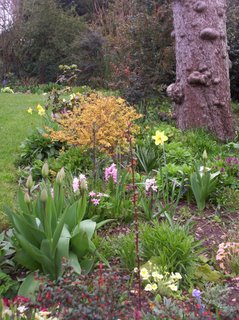 They say the preparations for a big wedding are all part of ‘the dance’, the bonding process; and I think a similar unity came into play for our 30th anniversary party. Let me get one thing straight immediately: we are not the partying type.
Since our 25th we’ve regularly celebrated with a trip to Scotland but this year we’re both going there in May so organising the travelling, not to mention the expense, all seemed a bit much. Besides, our garden is always at its best in April, with daffodils and primroses, tulips and blossom. Our friends and relatives should see it at its best . . . so we planned an open day: a garden party.
The invitations went out at Christmas saying, ‘Put it in your diary’; ‘Bring a folding chair’; and ‘With our collective positive thinking the sun will shine!’
Fat chance, it seemed, when the cold wind continued blowing and the daffodils remained little more than green spikes to within a week before. But then the sun warmed up and so did the soil.
Out of nearly 80 people invited it seemed nearly 50 would come, rain or shine. Was I mad?
30 years marriage to a one-time autocrat, punctuated with some near bust-ups has made me assertive: “If you turn the house upside down or get pedantic, I won’t do it,” I said, “they’ll take us as they find us.” And, “If you get the hump, I’ll cancel,” I threatened. Then, “Stop your sarcasm!” I ordered when I’d got better things to do, and, “Chill out!” when temperatures began to rise.
Food on the table, drinks on another, flowers everywhere and the grass freshly mown, the arrival of the ‘children’ and grandchildren heralded the beginning and they all mucked in to help. There was immediate interest in the storyboard I’d created from photos depicting ‘Our Lives Together’ with a brief but honest commentary.
Then at 1pm on the day, the guests began to drift in. My sisters, Rod’s brothers, friends from the pub, our neighbours, Rod’s climbing mates, my ex-colleagues, old school friends and more: everyone mixed and chatted. There were no barriers, no formalities, no speeches, no accidents . . .
The things that made it really special were:

* Relatives I’d not seen for years travelled hundreds of miles just for the afternoon’s celebration.
* People from all walks of life mixed in the most unlikely way – publicans with artists, computer buffs with ‘dinosaurs’.
* Nearly everyone wore warm clothes and sat happily outside making space to get at the food and storyboard indoors.
* My son's work in preparing the whole afternoon's music on computer in advance, playing it; and then giving us a live guitar rendition at the end.
* My daughter telling me, as she left, that I’d looked calm and happy all day.
* Nearly everyone signed our Visitors’ Book: a memento we intend to keep and perpetuate when we relocate to distant lands.
Our collective positive thinking worked!
Me? I enjoyed the day – the whole weekend – more than our wedding day 30 years ago. Love fuels love and when it seems to have depleted I recommend you pretend it’s still there, because it grows. The challenge, of course, awaits us with the next 30 years.
© Bernie Ross 2006
Monday, March 20, 2006
Who'll Take the Chair ?
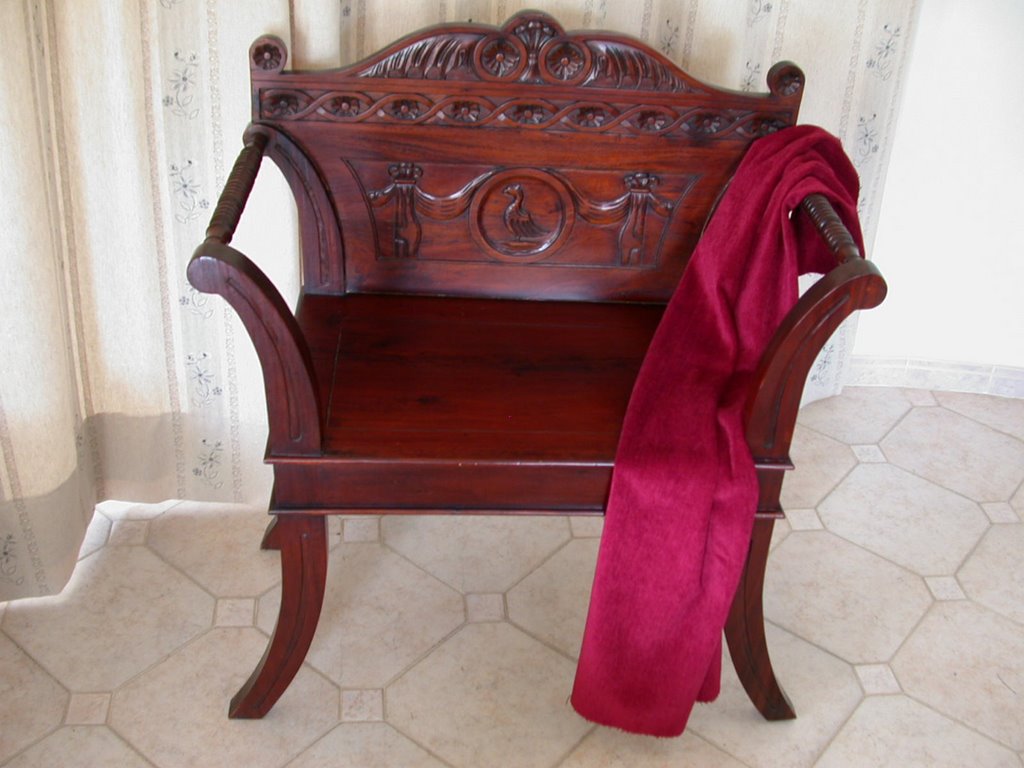
Who’ll Take the Chair?
by Barbara A. Rope
Schoolrooms and restaurants cannot function without them. The banquets in great halls wouldn’t quite be the same if tables had no companions to complete the room. After a good meal it’s good to sit down.
Fun loving, funky, free spirited and cheeky all describe chairs to entice you to buy. Plastic for leisure, ergonomic or stacking, massage machines incorporated within. Contemporary and classic they are all in the catalogues, just choose the one that suits you. After choosing, lie back; it’s good to relax.
I look around the house and see the movable four legged seats with a rest for our backs. After a busy day it’s good to sit down.
The variation is endless, they are designed for living and comfort.
They stand elegant and stylish in each of our homes, chosen for colour and texture, in beech, walnut or oak. Upholstered in materials of our choice
It’s a seat for one person. They began with authority to show who’s in charge. From Caesars to Popes, the chair has evolved. Bedecked and bejewelled with fine metals and pearls, adorned with silk and materials of style. The chair of the Bishop is known by its name, we copy the image and transfer it outside.
A model drapes herself around one and I see beauty and grace.
Photographs make them famous for supporting this scene, a statement of fashion to light up my eyes.
Turn on the radio and slip off your shoes and hear about more chairs, they are making the news. A Sheriff out West has used one before, it helps people so they don’t harm or be harmed. Listen harder, a seatbelt is mentioned for restraint. Turn up the volume and believe what you hear, he’s exporting them to Guantanamo Bay. Not for comfort or style or panache , but for forced feeding prisoners, these metal, movable four legged seats with a rest for the back.
It’s hard to sit down when you think of this chair. The hurt it causes, the pain and despair. The image it brings in my head is abhorrent. I thought we’ve moved on from torture with chairs.
Subscribe to:
Posts (Atom)
